SeoulCeuticals Vitamin C Serum vs TruSkin Vitamin C Serum: Korean Formulation Science vs Amazon's Most-Reviewed Vitamin C
Two Vitamin C serums at nearly identical price points, built on fundamentally different philosophies. SeoulCeuticals' Korean Vitamin C Serum replicates the SkinCeuticals C E Ferulic architecture — 20% L-ascorbic acid with Vitamin E and ferulic acid — at roughly one-eighth the benchmark price. TruSkin's Vitamin C Serum takes a different path: an undisclosed concentration with jojoba oil delivery and a user base of 148500+ Amazon reviews that no other Vitamin C serum in this price range can match. Same shelf, same budget, completely different formulation logic.
Quick Verdict: SeoulCeuticals wins on formulation transparency, disclosed concentration, and the clinically validated C+E+Ferulic synergy that made SkinCeuticals a gold standard. TruSkin wins on sheer volume of real-world validation — 148,000+ reviews represent the largest user dataset of any affordable Vitamin C serum, and the jojoba oil base provides a smoother application experience. Both oxidize at similar rates, both sit at the same price tier, and both deliver visible brightening for most skin types. Choose SeoulCeuticals if you want to know exactly what concentration you are applying. Choose TruSkin if the weight of collective user experience matters more than ingredient disclosure.
At a Glance
| Feature | SeoulCeuticals Korean 20% Vitamin C Hyaluronic Acid Serum | TruSkin Vitamin C Serum |
|---|---|---|
| Price Range | Under $25 | Under $25 |
| Size | 30ml / 1 fl oz | 30ml / 1 fl oz |
| Best Skin Type | Normal, oily, combination | All skin types |
| Key Ingredient | Vitamin C (L-Ascorbic Acid) + Ferulic Acid | Vitamin C (L-Ascorbic Acid) |
| Active Concentration | 20% Vitamin C | Not disclosed |
| Texture | Lightweight liquid serum | Lightweight liquid serum |
| Fragrance | Fragrance-free | Fragrance-free |
| See Availability | See Availability |
The SkinCeuticals Question: Who Copied the Formula?
In 2005, a research team led by Sheldon Pinnell at Duke University published findings that adding ferulic acid to a combination of 15% L-ascorbic acid and 1% Vitamin E doubled the formula's photoprotective capacity. SkinCeuticals commercialized this discovery as C E Ferulic — a serum that became the reference standard for Vitamin C formulation and currently sells for roughly eight times what either SeoulCeuticals or TruSkin charges. The study created a blueprint, and SeoulCeuticals built directly from it.
SeoulCeuticals states 20% L-ascorbic acid on its label — five percentage points above the original Pinnell study concentration — and includes both Vitamin E and ferulic acid. This is not a coincidence or a vague inspiration. The brand explicitly positions itself as a Korean-made alternative to SkinCeuticals, replicating the three-ingredient synergy at mass-market pricing. The 20% concentration sits at the upper end of what published research supports for topical efficacy. Above 20%, irritation increases without proportional benefit gains.
TruSkin does not follow the SkinCeuticals model. Its formula includes Vitamin C (form and concentration undisclosed on the label), Vitamin E, hyaluronic acid, and jojoba oil — but no ferulic acid. The absence of ferulic acid means TruSkin lacks the specific amplifier that the Pinnell study identified as the key multiplier. This does not make TruSkin ineffective — Vitamin C alone is a well-documented antioxidant and brightening agent — but it does mean the formula operates on a different scientific foundation than SeoulCeuticals.
For buyers who care about formulation architecture, the distinction matters. SeoulCeuticals gives you a formula designed around published clinical research with every active ingredient disclosed. TruSkin gives you a Vitamin C serum validated by the market rather than the lab. Both approaches have merit. One tells you why it should work. The other shows you that it does.
The 148,000-Review Advantage
TruSkin's review count is not just a marketing number — it is a statistical asset that no other affordable Vitamin C serum possesses. At 148,000+ verified Amazon reviews with a 4.3-star average, the dataset is large enough to represent virtually every skin type, climate, age group, and routine combination. When a product maintains a 4.3 rating across that volume, the signal is strong: the formula works for a broad population under real-world conditions. No clinical trial matches that sample size or diversity of conditions.
SeoulCeuticals has earned over 27,000 reviews at 4.2 stars — a strong showing by any standard, but roughly one-fifth of TruSkin's volume. The 0.1-star rating difference is statistically negligible at these sample sizes. What matters is the confidence interval: with 148,000 reviews, TruSkin's 4.3 average is locked in. With 27,000 reviews, SeoulCeuticals' 4.2 still has room to shift. Both ratings reflect genuine user satisfaction, but TruSkin's larger base gives buyers more predictive confidence about their own likely experience.
Digging into the negative reviews reveals different complaint patterns. SeoulCeuticals' 1-star reviews cluster around stinging on sensitive skin — a predictable side effect of 20% L-ascorbic acid and a sign that the concentration is genuinely high. TruSkin's negative reviews more often mention slow results or product texture, which suggests a lower active concentration producing gentler but slower effects. The complaint profiles actually reinforce each product's formulation identity: SeoulCeuticals is potent enough to sting, TruSkin is mild enough to underwhelm some users looking for rapid change.
Concentration and Transparency
SeoulCeuticals discloses 20% L-ascorbic acid on the label. TruSkin does not disclose its concentration. This single difference shapes the entire comparison for informed buyers. Concentration determines efficacy ceiling — published dermatological research consistently shows that L-ascorbic acid performs best between 10-20% for topical application. Below 10%, the antioxidant and brightening effects are measurable but modest. Above 20%, irritation climbs sharply with diminishing returns. SeoulCeuticals positions itself at the top of the effective range. TruSkin asks you to trust the results without knowing where on that spectrum you land.
The transparency gap extends beyond the active ingredient. SeoulCeuticals lists ferulic acid and Vitamin E as named synergists — ingredients with a specific, published role in the formula. TruSkin lists Vitamin E and jojoba oil, but the formulation rationale is less explicit. Jojoba oil is an emollient and carrier — it improves texture and skin feel — but it does not amplify Vitamin C the way ferulic acid does. The ingredient lists tell different stories: SeoulCeuticals reads like a formula designed around clinical research, TruSkin reads like a formula designed around user experience.
For buyers with skincare knowledge who want to make concentration-based decisions — comparing against their dermatologist's advice, layering with other actives at known percentages, or matching against the clinical literature on Vitamin C efficacy — SeoulCeuticals provides the information needed. For buyers who care more about outcomes than ingredients and trust the weight of 148,000 user reports, the undisclosed concentration is not a dealbreaker. It is a philosophical difference in how each brand earns trust.
Texture, Application, and Daily Use
SeoulCeuticals applies as a thin, watery liquid with a faintly tacky finish. The 20% L-ascorbic acid formulation has a low pH — around 2.5-3.5 — which can produce a mild tingling or warmth on application. This is not a defect; it is the active ingredient doing its job. The tingling fades within 60-90 seconds for most users. The liquid consistency means the serum spreads quickly with the glass dropper, absorbs within two minutes, and layers cleanly under moisturizer and sunscreen. Users with oily skin report no residual greasiness.
TruSkin's formula includes jojoba oil, which gives the serum a slightly thicker, more emollient texture compared to SeoulCeuticals' waterlike consistency. The jojoba smooths the application experience — less tingling, less dryness, a more "skincare" feel during use. For first-time Vitamin C users or anyone who finds L-ascorbic acid serums too austere, TruSkin's texture is more approachable. The trade-off: users with oily or combination skin sometimes report a faint oily sheen that takes 5-10 minutes to fully absorb, especially in humid conditions.
Morning routine compatibility matters because Vitamin C works best as a daytime antioxidant. Both serums layer under sunscreen without pilling, but TruSkin's jojoba oil base can interfere with matte-finish sunscreens. SeoulCeuticals' thinner formula sits flatter under mineral and chemical sunscreens alike. For users who apply makeup over sunscreen, SeoulCeuticals creates less disruption in the stack. For users who skip makeup and want the serum to double as light hydration, TruSkin's oilier base adds a small moisture boost that SeoulCeuticals does not provide.
Oxidation and Shelf Stability
L-ascorbic acid is inherently unstable. It reacts with oxygen and light, converting to dehydroascorbic acid and eventually to compounds that can cause skin discoloration rather than prevent it. Both SeoulCeuticals and TruSkin face this limitation equally — neither formula contains advanced stabilizers like those found in airless pump systems or anhydrous formulations. Both use dark-tinted glass dropper bottles to reduce light exposure, and both oxidize within 2-3 months of opening under normal bathroom storage conditions.
The oxidation timeline is nearly identical for practical purposes. Both serums start clear to pale yellow. After 6-8 weeks of daily use, they begin shifting toward a deeper gold. By 10-12 weeks, the color approaches amber — the point at which most dermatologists recommend replacing the product. The SeoulCeuticals formula includes ferulic acid, which does have mild antioxidant-stabilizing properties for the L-ascorbic acid itself, but the effect extends shelf life by days rather than weeks. TruSkin's jojoba oil does not contribute to vitamin C stabilization.
The practical implication: budget for a new bottle every 2-3 months with either serum. At budget-friendly pricing for both, quarterly replacement is financially manageable. Store both serums inside a closed medicine cabinet or drawer — not on an open shelf where light accelerates degradation. If you notice the serum turning distinctly orange, stop using it. Oxidized Vitamin C is not dangerous, but it is no longer delivering the brightening or antioxidant benefits you purchased it for, and the oxidized byproducts can leave a temporary yellow tint on lighter skin tones.
Packaging and Product Design
Both serums ship in dark-tinted glass bottles with dropper dispensers — the standard packaging for L-ascorbic acid serums. The dark tint filters UV and visible light wavelengths that accelerate oxidation. Glass prevents the chemical leaching that can occur when acidic (low-pH) formulas sit in plastic containers for months. On packaging fundamentals, both brands made the correct material choices for the ingredient they are protecting.
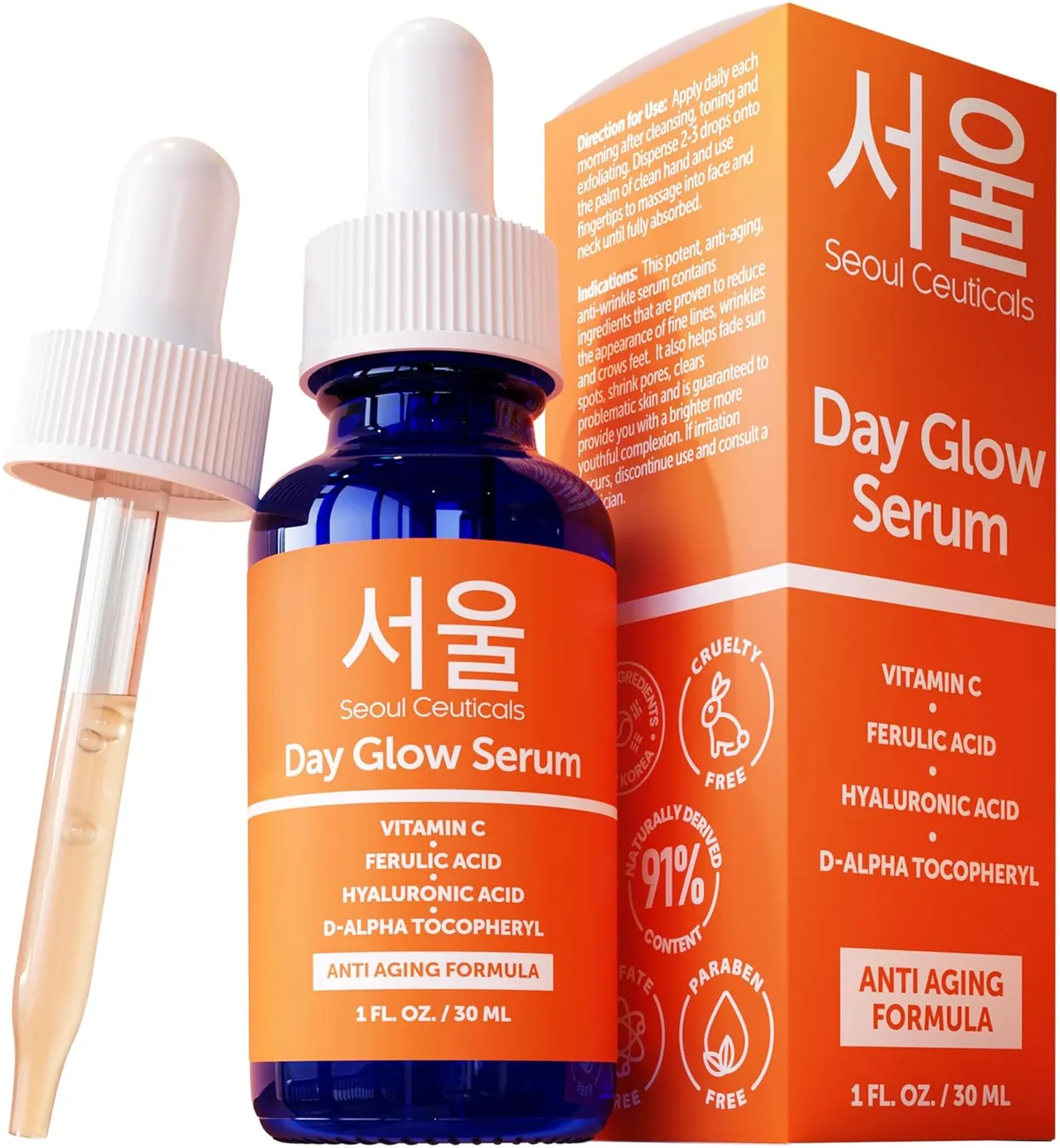
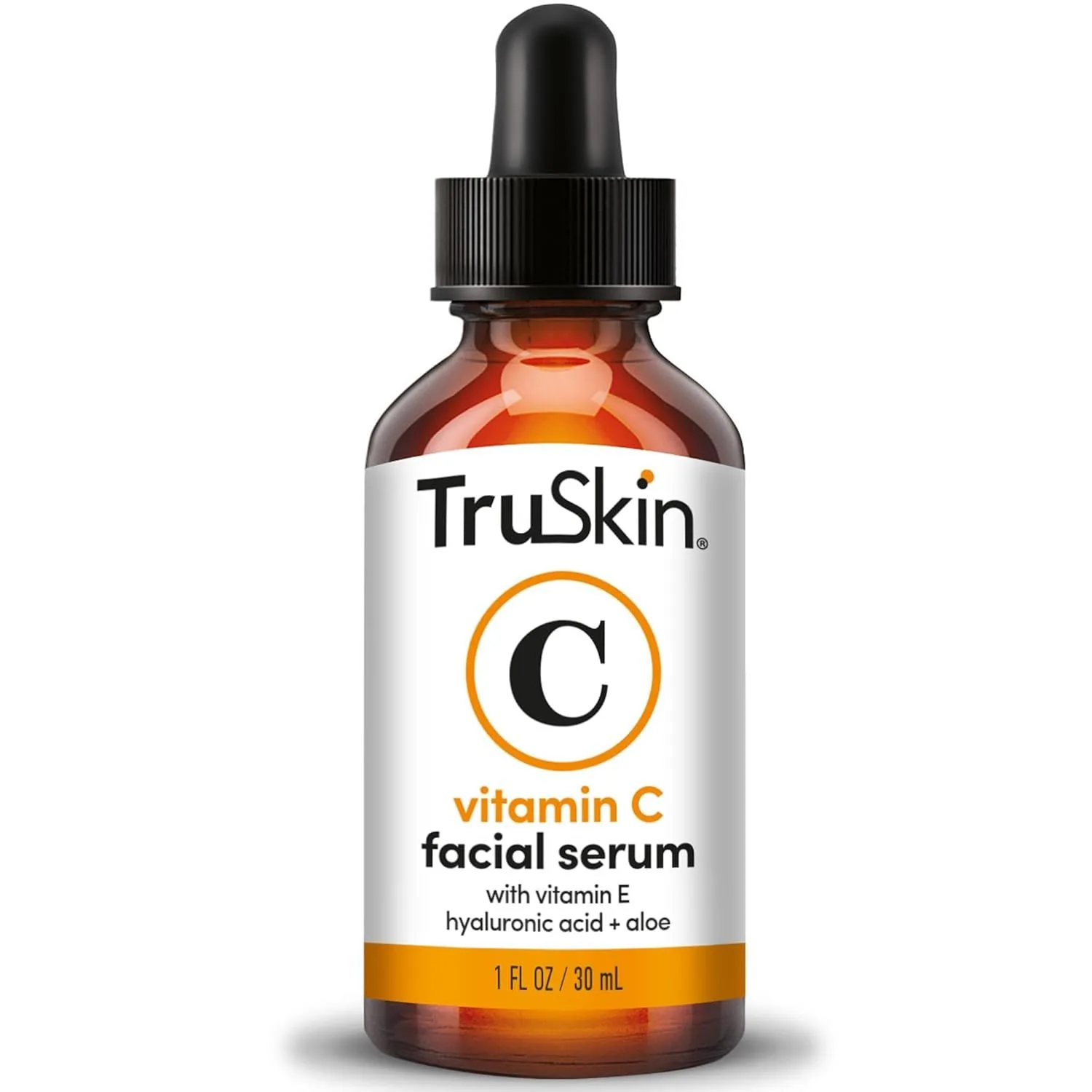
SeoulCeuticals' bottle is compact and slightly heavier, with a screw-cap dropper that seals tightly between uses. The labeling is minimal — the "Day Glow Serum" subtitle is the main visual identifier, which actually causes confusion among some buyers who do not realize they are purchasing a 20% L-ascorbic acid active serum rather than a cosmetic glow product. TruSkin's bottle is similar in size with a rubber dropper bulb and a label design that has become one of the most recognizable in Amazon skincare. The orange-and-green branding stands out in search results and subscriber reorder lists.
Neither bottle uses an airless pump, which would be the gold standard for protecting L-ascorbic acid from oxygen exposure. Every time you unscrew the cap and draw serum into the dropper, air enters the bottle. Over 2-3 months of twice-daily opening, this cumulative oxygen exposure is the primary driver of oxidation. For buyers who want maximum stability, transfer the serum to an airless pump bottle after purchase — a small added step that can extend usable life by 2-4 weeks. Neither brand offers this packaging upgrade, which represents an opportunity both are leaving on the table.
Who Each Serum Is Designed For
SeoulCeuticals targets the ingredient-aware buyer — someone who reads labels, compares concentrations, and understands why the C+E+ferulic combination matters. The product positions itself as a direct SkinCeuticals alternative for buyers who want the same formulation logic without the prestige markup. If you have read the research on L-ascorbic acid concentrations and want to apply a serum where you know exactly what percentage is touching your skin, SeoulCeuticals provides that information. The brand earns trust through transparency and clinical alignment.
TruSkin targets the results-oriented buyer — someone who cares about outcomes, reads reviews, and trusts collective user experience over ingredient lists. The 148,000+ review count is TruSkin's primary credential, and it is a legitimate one. For buyers who are new to Vitamin C serums and want the lowest-risk entry point — defined by the largest pool of people who have already tried and approved the product — TruSkin offers the safety of the crowd. The brand earns trust through scale and consistency.
Neither audience is wrong. The ingredient-focused buyer and the results-focused buyer are simply using different decision frameworks. Where those frameworks converge: both serums are priced identically, both deliver visible brightening for most users, and both require the same storage and replacement cadence. The choice reduces to a single question — do you trust the formula or the crowd?
Skin Type Compatibility
Oily skin: SeoulCeuticals' watery formula absorbs faster and leaves no oily residue. TruSkin's jojoba oil content adds a slight sheen that oily skin types may find unwelcome, especially in warm or humid conditions. For oily skin, SeoulCeuticals integrates more cleanly into a morning routine under sunscreen.
Dry skin: TruSkin's jojoba oil provides a thin hydration layer that dry skin benefits from. SeoulCeuticals' leaner formula offers no emollient support — dry skin types will need a dedicated hydrating serum or moisturizer immediately after application. For dry skin, TruSkin's formula pulls double duty as a mild hydrator.
Sensitive skin: This is where concentration matters most. SeoulCeuticals at 20% L-ascorbic acid will sting on reactive skin — the brand's own negative reviews confirm this repeatedly. TruSkin's likely lower concentration produces less initial irritation, making it the safer pick for first-time Vitamin C users or anyone with a history of sensitivity to active ingredients. Start with TruSkin and graduate to SeoulCeuticals once your skin has adapted to L-ascorbic acid.
Mature skin: Higher concentrations of L-ascorbic acid produce more visible anti-aging results in published studies. For users over 40 seeking collagen stimulation and photoaging reversal, SeoulCeuticals' 20% concentration puts it closer to the clinically effective threshold documented in dermatological literature. TruSkin's undisclosed concentration creates uncertainty about whether it delivers enough active ingredient to drive the cellular changes mature skin needs. For the best Vitamin C options across all categories, see our complete Vitamin C serum rankings.
How to Layer Each Serum in Your Routine
Morning application is recommended for both serums — Vitamin C provides antioxidant protection against UV-generated free radicals, which makes it a daytime active. Apply to clean, dry skin after cleansing. Wait 60-90 seconds for full absorption before layering sunscreen. Both serums sit well under SPF 30+ formulas, though SeoulCeuticals' thinner texture creates less friction under sunscreen than TruSkin's jojoba-enriched base.
For users who also apply a hyaluronic acid serum: apply the Vitamin C serum first (lower pH, thinner consistency), wait two minutes for absorption, then follow with hyaluronic acid. Reversing the order dilutes the Vitamin C's contact with skin at its optimal pH and reduces efficacy. Both SeoulCeuticals and TruSkin already contain some hyaluronic acid in their formulas, so the additional HA layer is optional and primarily benefits dehydrated or dry skin types.
Evening use is acceptable but less optimal. Vitamin C's antioxidant protection against daytime environmental stress is wasted if applied at night. If your evening routine already includes retinol or an exfoliating acid (AHA/BHA), avoid layering Vitamin C on the same night — the pH conflict between L-ascorbic acid and retinol reduces the performance of both actives. Alternate nights or separate into AM (Vitamin C) and PM (retinol) for the strongest results from each ingredient.
The Value Equation
Both serums sit at the same budget-friendly tier for 30ml. This is unusual in a comparison — most head-to-head matchups involve a price gap that forces a value calculation. Here, the calculation is purely about what each formula delivers per dollar, not about different spending thresholds. SeoulCeuticals gives you a disclosed 20% concentration of the most studied form of Vitamin C, plus the C+E+ferulic synergy. TruSkin gives you an undisclosed concentration with jojoba oil delivery and 5x the user validation. Dollar for dollar, the question is not which costs less — it is which delivers more of what you personally value.
The quarterly replacement cost is identical. Both oxidize in 2-3 months. Both require a fresh bottle four to five times per year for consistent use. Over a full year, you spend the same amount regardless of which serum you choose. The only variable that could shift the value equation is if one serum delivers your desired results faster — and based on review analysis, SeoulCeuticals tends to show visible brightening in 2-3 weeks while TruSkin averages 3-5 weeks. Faster results from SeoulCeuticals mean fewer days of use per visible outcome, which is a marginal efficiency advantage that compounds over a year of use.
Picking the Right Serum for Your Goals
Get SeoulCeuticals Vitamin C Serum If...
- You want a disclosed 20% L-ascorbic acid concentration — knowing the exact potency matters for your routine decisions and dermatologist consultations
- The C+E+ferulic synergy is important to you — this specific three-ingredient combination has more published clinical support than any other Vitamin C formulation
- You have experience with active ingredients and your skin can tolerate a high-potency formula without a break-in period
- Faster brightening timeline is a priority — the 2-3 week average for visible results outpaces most affordable Vitamin C serums
- You have oily or combination skin and need a serum that absorbs without leaving any oily residue
Get TruSkin Vitamin C Serum If...
- You are new to Vitamin C serums and want the lowest-risk entry point backed by the largest user validation dataset on Amazon
- Your skin is sensitive and you need a gentler introduction to L-ascorbic acid before moving to higher concentrations
- The jojoba oil texture appeals to you — smoother application, mild hydration, and less of the austere "active serum" feel
- You trust collective user experience over ingredient label specifics — 148,000+ reviews represent a data point that no clinical trial can replicate
- You have dry skin and want a serum that provides a light moisture layer alongside brightening actives
Final Assessment
This comparison comes down to two different philosophies of trust. SeoulCeuticals asks you to trust the formula — a transparent, research-backed combination of 20% Vitamin C, Vitamin E, and ferulic acid that replicates the most validated antioxidant serum architecture in dermatology. TruSkin asks you to trust the results — an unprecedented volume of real-world user data showing consistent brightening outcomes across the broadest possible range of skin types, climates, and routines.
Neither philosophy is wrong, and neither serum is clearly superior. SeoulCeuticals gives you more information and a higher disclosed concentration. TruSkin gives you more validation and a gentler user experience. Both oxidize at the same rate, sit at the same price, and require the same quarterly replacement. SeoulCeuticals is the best budget Vitamin C for ingredient-literate buyers; TruSkin is the best for first-timers who want the safety of crowd validation. The right choice depends entirely on whether you are the type of buyer who reads the label first or the reviews first.
If you want to understand how both of these serums compare against the full Vitamin C market — including premium options from SkinCeuticals, Drunk Elephant, and Obagi — our best Vitamin C serums ranking covers every tier from budget to luxury. And for the science behind why Vitamin C concentration, pH, and companion ingredients matter, our Vitamin C in skincare guide provides the clinical context that makes comparisons like this one more useful.
Common Questions About These Serums
Does SeoulCeuticals actually replicate the SkinCeuticals C E Ferulic formula?
SeoulCeuticals follows the same foundational logic: 20% L-ascorbic acid combined with Vitamin E and ferulic acid. This trio was first validated in a 2005 study by Duke University researchers, which found that ferulic acid doubles the photoprotection of a C+E combination. SeoulCeuticals uses this published synergy at a fraction of SkinCeuticals pricing. The exact ratios and stabilization methods differ — SkinCeuticals holds a patent on its specific formulation — but the active ingredient architecture is intentionally parallel.
Why does TruSkin not disclose its Vitamin C concentration?
TruSkin markets its serum as a Vitamin C product but lists L-ascorbic acid without a percentage on the label. This is common among mass-market serums — the FDA does not require concentration disclosure for cosmetic ingredients. The practical implication: you cannot compare potency directly against serums like SeoulCeuticals that state 20%. Based on user-reported results and formulation analysis, industry observers estimate TruSkin falls in the 10-15% range, though the brand has not confirmed this.
How can I tell if my Vitamin C serum has oxidized?
Fresh L-ascorbic acid serum is clear to very pale yellow. As it oxidizes, it shifts to amber, then orange, then dark brown. A light golden tint is still usable. Once the serum turns distinctly orange, its Vitamin C potency has dropped below the threshold where it delivers measurable benefits. Both SeoulCeuticals and TruSkin use dark-tinted glass to slow this process, but neither contains stabilizers strong enough to prevent oxidation beyond 2-3 months after opening. Store both in a cool, dark place — a medicine cabinet is ideal.
Can I use either serum with retinol at night?
Apply Vitamin C in the morning and retinol at night. Using both simultaneously can cause irritation and reduce effectiveness — L-ascorbic acid works best at a low pH (around 3.5), while retinol performs optimally at a higher pH. Separating them by 12 hours gives each active its ideal environment. If you want to layer both in the same routine, apply the Vitamin C first, wait 15-20 minutes for full absorption and pH normalization, then apply retinol. Morning Vitamin C also provides daytime antioxidant protection that retinol cannot.
Which serum works faster for dark spots and hyperpigmentation?
SeoulCeuticals typically shows faster brightening results — most users report visible changes in 2-3 weeks. The disclosed 20% concentration and the ferulic acid amplifier likely drive the faster timeline. TruSkin users report brightening in 3-5 weeks on average, based on review analysis across its 148,000+ review base. Both require consistent daily use. Neither will fade deep melasma or post-inflammatory hyperpigmentation alone — those conditions need dermatologist-guided treatment with prescription agents like hydroquinone or tranexamic acid.
Is it worth paying the small price difference between these two serums?
Both serums sit at nearly the same price point, which makes this comparison about formula philosophy rather than budget. SeoulCeuticals gives you a disclosed 20% concentration and the C+E+ferulic synergy — you know exactly what you are getting and why. TruSkin gives you a formula validated by the largest user base of any Vitamin C serum on Amazon, with jojoba oil for enhanced delivery. The price difference is negligible. Choose based on whether you prioritize formulation transparency or volume of proven results.

