The Ordinary Daily Set vs Tree of Life Trio: Hydration Basics or Active Treatment Trio?
The Ordinary Daily Set wins this comparison for skincare beginners who want a complete daily routine in one box — cleanser, hydrating serum, and moisturizer, all proven standalone bestsellers, all fragrance-free. Tree of Life Brightening Trio wins for anyone ready to test active ingredients — Vitamin C, retinol, and hyaluronic acid — at the lowest possible entry price. Both sit at modestly more expensive, firmly in budget territory. The split comes down to what your skin actually needs right now: a reliable daily foundation with zero learning curve, or a discovery set that introduces three of the most researched actives in skincare. One builds your floor. The other lets you experiment with your ceiling.
Quick Verdict: The Ordinary Daily Set is the better first skincare purchase — three products that form a complete cleanse-hydrate-moisturize routine, each one a bestseller in The Ordinary's catalog. Tree of Life Trio is the better second purchase — three active serums (Vitamin C, retinol, hyaluronic acid) that introduce treatment ingredients your skin will eventually need. If you own nothing and want to start a routine today, The Ordinary is the answer. If you already cleanse and moisturize but want to add anti-aging or brightening, Tree of Life fills that gap for less than the cost of a single premium serum.
At a Glance
| Feature | The Ordinary The Daily Set | Tree of Life Brightening & Hydrating Trio |
|---|---|---|
| Price Range | Under $25 | $25–$50 |
| Size | 50ml cleanser + 30ml serum + 30ml moisturizer | 3 × 30ml (90ml total) |
| Best Skin Type | All skin types | All skin types, beginners |
| Key Ingredient | Squalane + Hyaluronic Acid 2% + B5 | Vitamin C + Retinol + HA Trio |
| Active Concentration | 2% Hyaluronic Acid (serum) | Entry-level concentrations |
| Texture | Balm cleanser + liquid serum + light cream | Three liquid serums |
| Fragrance | Fragrance-free | Fragrance-free |
| See Availability | See Availability |
Inside Each Box: Three Products, Two Different Philosophies
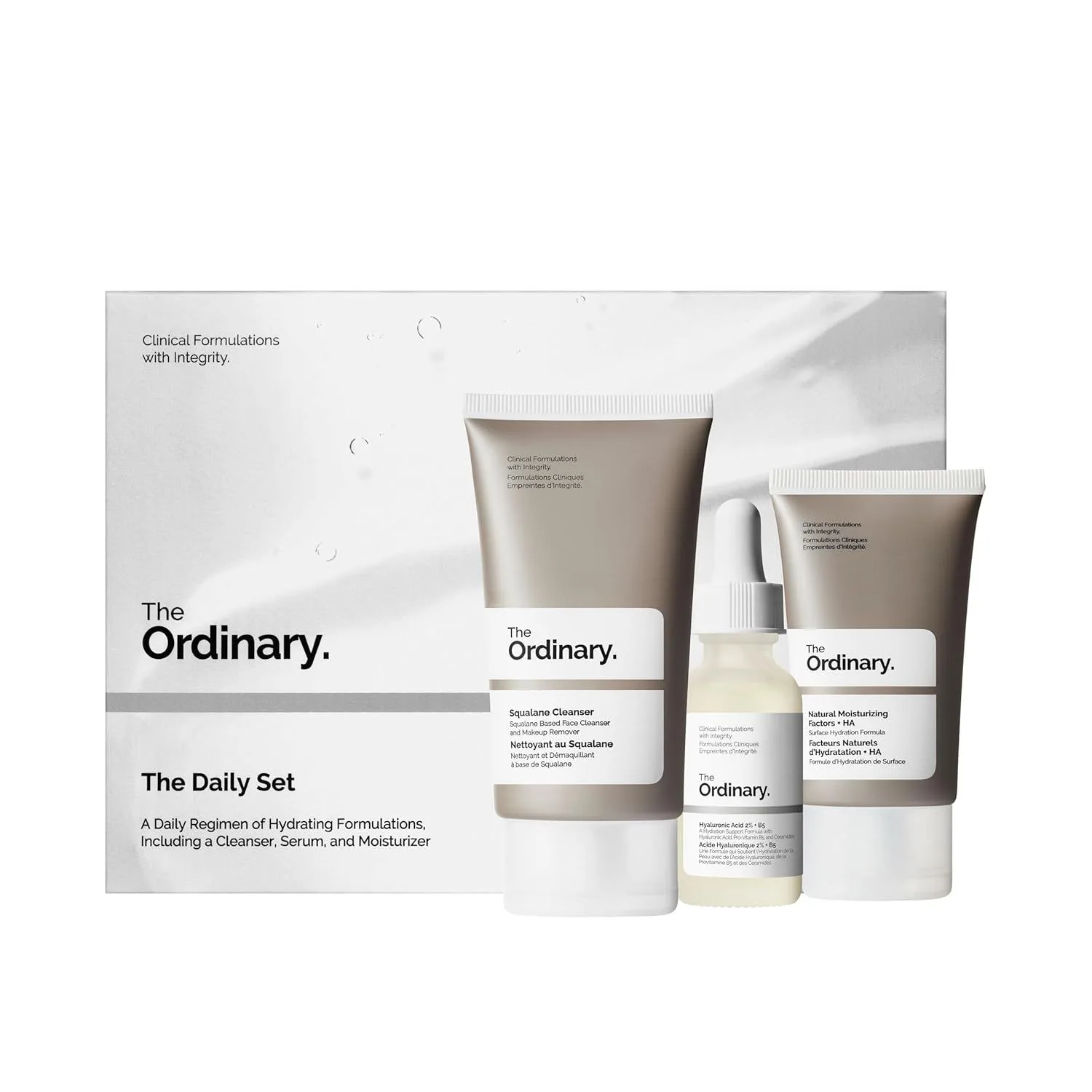
The Ordinary Daily Set ships three products: the Squalane Cleanser (50ml), Hyaluronic Acid 2% + B5 serum (30ml), and Natural Moisturizing Factors + HA moisturizer (30ml). Each product is a standalone bestseller in The Ordinary's lineup — these are not filler items created to pad a bundle. The Squalane Cleanser is a balm-to-oil formula that dissolves makeup and sunscreen without foaming agents or harsh surfactants. The HA serum uses multi-weight hyaluronic acid (low, medium, and high molecular weight) combined with Vitamin B5 to draw and retain moisture at multiple skin depths. The moisturizer replicates the skin's own Natural Moisturizing Factors — amino acids, fatty acids, and ceramide precursors — to reinforce the moisture barrier. Together, they form a clean three-step routine: dissolve, hydrate, seal.
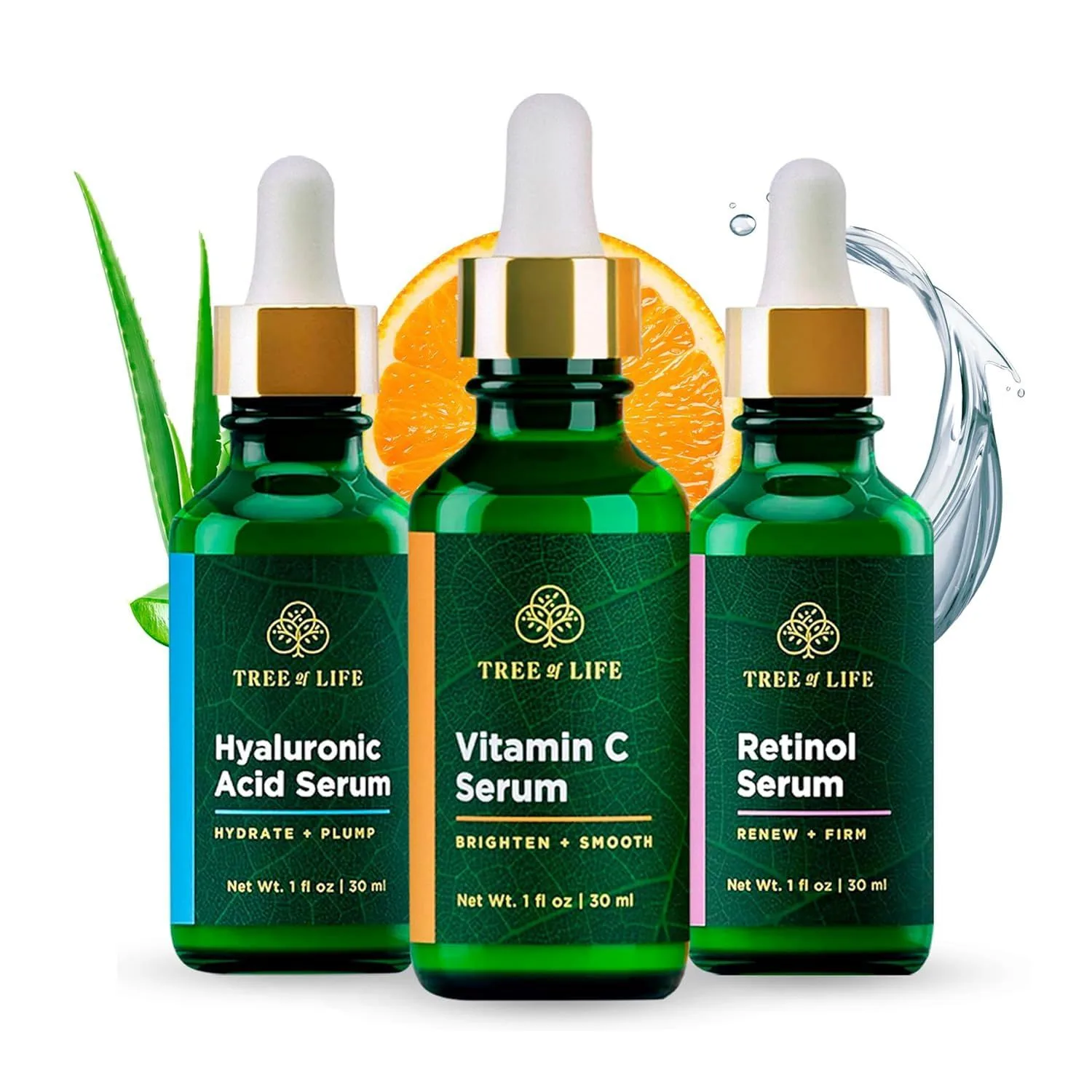
Tree of Life Brightening Trio ships three serums: Vitamin C serum, retinol serum, and hyaluronic acid serum. Each is a 30ml full-size bottle with a dropper applicator. The Vitamin C serum targets uneven skin tone, dark spots, and environmental damage through antioxidant activity. The retinol serum promotes cell turnover — the mechanism behind reduced fine lines, smoother texture, and faded hyperpigmentation. The hyaluronic acid serum provides deep hydration by pulling moisture from the environment into the skin. These are treatment products. They address specific skin concerns through active ingredients backed by decades of dermatological research.
The distinction matters because these sets solve different problems. The Ordinary gives you a complete daily routine — everything you need from face wash to final moisturizer. Tree of Life gives you three active treatments, but no cleanser and no moisturizer. You cannot use Tree of Life serums in isolation; they need a cleanser before and a moisturizer after to function properly in a skincare routine. The Ordinary is a finished system. Tree of Life is a treatment layer that fits inside an existing system. Understanding this difference is the entire key to choosing between them.
The Active Ingredient Gap: Hydration Foundation vs Treatment Firepower
The Ordinary's daily set contains one active ingredient: hyaluronic acid at 2% concentration with Vitamin B5 support. Hyaluronic acid is a humectant — it binds water molecules and holds them against the skin surface. At 2%, The Ordinary's formulation is effective for baseline hydration. The Squalane Cleanser and NMF moisturizer contribute functional ingredients (squalane, amino acids, phospholipids), but these are barrier-support compounds, not treatment actives. The set is designed to maintain healthy skin, not to change it. If your skin is fundamentally clear and you want to keep it that way, this is the right approach.
Tree of Life delivers three distinct active categories in separate bottles. Vitamin C (as ascorbic acid) is the most studied topical antioxidant — it neutralizes free radicals from UV exposure and pollution, inhibits melanin overproduction, and supports collagen synthesis. Published research in the Journal of Clinical and Aesthetic Dermatology confirms that topical Vitamin C at concentrations above 8% produces measurable improvements in photoaged skin within 12 weeks. Retinol (vitamin A derivative) accelerates epidermal cell turnover from the standard 28-day cycle to as fast as 14-21 days, pushing fresh cells to the surface while clearing dead ones that cause dullness and texture. Hyaluronic acid in the Tree of Life set performs the same hydration function as The Ordinary's version — drawing and binding moisture.
The gap is not subtle. The Ordinary offers hydration through one well-formulated serum. Tree of Life offers hydration plus anti-aging plus brightening plus texture refinement through three serums with three different mechanisms of action. For someone whose skin concern is dryness alone, The Ordinary covers it completely. For someone dealing with early fine lines, sun spots, uneven tone, or dull texture, Tree of Life provides treatment pathways that The Ordinary's hydration-only approach cannot address. Our skincare sets roundup breaks down how active-ingredient count affects long-term results across every set we reviewed.
Brand Reputation and Ingredient Transparency
The Ordinary changed the skincare industry when it launched in 2016 by publishing exact ingredient concentrations on every product label. Before The Ordinary, most brands hid behind proprietary blend language — "contains hyaluronic acid" without specifying how much. The Ordinary printed "Hyaluronic Acid 2% + B5" directly on the bottle. This transparency became the brand's identity and attracted a following of ingredient-literate consumers who wanted to know precisely what they were applying. The parent company, DECIEM, operates under the same transparency ethos across its entire portfolio. Every product in the Daily Set displays its key active, its concentration, and its purpose on the front label.
Tree of Life operates in a different tier of brand awareness. The company has been selling on Amazon since 2015 and has accumulated over 45,000 reviews on the Brightening Trio alone — a staggering number that puts it among the most-purchased skincare products on the platform. The formulations are honest for the price point, and the review volume provides enormous field-testing data. Where Tree of Life falls short is concentration transparency. The serums list their active ingredients but do not publish exact percentages on the label. You know the Vitamin C serum contains ascorbic acid. You do not know whether the concentration is 5%, 10%, or 15%. For beginners, this omission rarely matters — entry-level concentrations work fine for first-time users. For experienced skincare buyers who calibrate their routine around specific percentages, the ambiguity is a real limitation.
The Ordinary's published concentrations allow you to make informed decisions about layering, about when to increase strength, and about how their products interact with other brands in your routine. Tree of Life's undisclosed concentrations mean you are trusting the formulator without verification. Both brands deliver on their promises at their price points. But The Ordinary gives you the data to understand why, and that transparency has built a level of consumer trust that few budget brands can match.
Anti-Aging and Skin Improvement Potential
This is where Tree of Life pulls away from The Ordinary with a gap that no amount of brand prestige can close. Retinol is the single most validated anti-aging ingredient available without a prescription. Peer-reviewed studies published across four decades consistently demonstrate that topical retinol reduces fine line depth, increases collagen density, fades hyperpigmentation, and improves skin texture when used consistently over 8-12 weeks. No ingredient in The Ordinary's daily set performs any of these functions. Hyaluronic acid plumps the skin temporarily by retaining water — a visible but transient effect that reverses when you stop applying it. Retinol produces structural changes in the dermis that persist beyond the application period.
The Vitamin C serum in the Tree of Life set adds a second anti-aging vector. While retinol works from the inside out (accelerating cell turnover), Vitamin C works from the outside in (neutralizing environmental damage before it reaches deeper skin layers). The two ingredients complement each other through different mechanisms — retinol rebuilding, Vitamin C protecting. Using both in the same routine (Vitamin C mornings, retinol evenings) is one of the most widely recommended combinations in clinical dermatology.
The Ordinary's daily set was not designed to address aging. Its purpose is daily maintenance — keeping skin clean, hydrated, and barrier-protected. For a 20-year-old with clear skin, that maintenance routine is often sufficient. For anyone over 28 or anyone noticing the first signs of fine lines, sun damage, or uneven tone, Tree of Life provides the treatment ingredients that actually address those changes at the cellular level. The full Tree of Life review covers each serum's anti-aging mechanism in detail.
The Beginner Experience: Simplicity vs Discovery
Someone buying their first skincare set faces a specific anxiety: "Will I know how to use this?" The Ordinary's daily set eliminates that anxiety entirely. Three products, three steps, one sequence. Cleanser goes first — apply to dry skin, massage, rinse. Serum goes second — apply 2-3 drops to damp skin, press in. Moisturizer goes last — apply a pea-sized amount, spread evenly. Morning and evening, same order. The routine takes under two minutes. There is no decision-making involved, no research required, no risk of applying products in the wrong sequence. You open the box and start.
Tree of Life presents a different experience. Three serums arrive without a cleanser or moisturizer, which means a true beginner needs to buy additional products before the set is usable. Once you have a cleanser and moisturizer from another source, the next question is application order and frequency. Do you use all three serums at once? (No — that overloads your skin with actives.) Do Vitamin C and retinol go in the same routine? (Generally not — Vitamin C mornings, retinol evenings.) How often should you use retinol when starting out? (Two to three nights per week, building to nightly over four to six weeks.) These answers exist, but you need to find them yourself. Tree of Life does not include a routine guide in the box.
The learning curve is the hidden cost of Tree of Life's active-ingredient advantage. You get more powerful products, but you bear the responsibility of using them correctly. Retinol applied too frequently causes peeling, redness, and a "purging" phase that panics first-timers into abandoning the product prematurely. Vitamin C stored improperly oxidizes and turns orange, becoming ineffective. Hyaluronic acid applied to dry skin in arid climates can actually pull moisture out of the skin rather than into it. Each of these problems is avoidable with basic knowledge — but the knowledge is required, not optional. The Ordinary's hydration-only approach sidesteps all of these concerns entirely.
Discovery Value: Testing Actives Without Financial Risk
Tree of Life's brightening trio exists to answer a question that millions of skincare beginners ask: "Do Vitamin C, retinol, and hyaluronic acid actually work on my skin?" Finding out typically requires buying three separate serums from three different brands at three different price points. A mid-range Vitamin C serum runs in the mid-range bracket. A respected retinol costs similarly. Add hyaluronic acid and the total investment to test three actives approaches triple digits before you know whether any of them suit your skin type. Tree of Life compresses that experiment into a single purchase at affordably priced pricing. The concentrations are entry-level, not clinical-strength — but that is the correct approach for a discovery product. You want to know if your skin tolerates retinol before spending on a high-concentration formula.
The Ordinary's daily set offers a different kind of discovery — it teaches the daily routine itself. For someone who has never consistently washed, treated, and moisturized their face, the three-step sequence is the foundational habit that makes all future skincare work. The products are excellent at their jobs, and the routine they establish becomes the scaffold onto which you add actives later. But the products themselves are not discovery items. Squalane cleansing, hyaluronic acid hydration, and NMF moisturizing are straightforward, well-understood formulations. There is no "will this ingredient work for me?" question to answer — these ingredients work for everyone.
Tree of Life's discovery value is real and measurable. After 8-12 weeks with the trio, you will know whether Vitamin C brightens your specific skin tone, whether retinol improves your specific texture concerns, and whether your skin responds better to HA as a standalone serum or as a moisturizer ingredient. That information has genuine value — it prevents wasted spending on premium versions of actives that do not suit your biology. The Ordinary teaches you how to do skincare. Tree of Life teaches you which active ingredients your skin responds to. Both lessons matter; they just arrive at different stages of the skincare journey.
Individual Product Quality: Bestsellers vs Bulk Value
Every product in The Ordinary's daily set exists as a standalone bestseller in The Ordinary's catalog. The Squalane Cleanser consistently ranks among the top five cleansers on multiple beauty retailer sites. The Hyaluronic Acid 2% + B5 serum has appeared on countless dermatologist-recommended lists. The Natural Moisturizing Factors + HA moisturizer is widely cited as one of the best budget moisturizers available. These are not products designed to fill a box — they were hits individually before being bundled together. The set represents The Ordinary's greatest hits, packaged at a lower per-product cost than buying them separately.
Tree of Life serums are formulated as a trio from the start, not compiled from individual bestsellers. The quality is honest — reviewers consistently note that the serums perform well for the price, and the 45,000+ review count on Amazon provides massive confirmation of real-world efficacy. The Vitamin C serum brightens. The retinol smooths. The HA hydrates. But the individual formulations do not carry the same standalone reputation as The Ordinary's products. Tree of Life has built its brand on the trio itself, not on each serum as a separate product. The difference shows in packaging (generic dropper bottles versus The Ordinary's clinical-grade aesthetic), in formulation details (undisclosed versus published concentrations), and in the overall product experience.
The Ordinary commands higher consumer confidence because each product has been individually validated by millions of purchasers, reviewed by hundreds of dermatologists, and stress-tested across every possible skin type and climate. Tree of Life has been validated by volume — 45,000 reviews is an enormous sample size — but primarily as a bundle, not as three independent products. If product quality is the primary criterion, The Ordinary delivers a more refined, more transparent, and more individually proven set. Our full Ordinary Daily Set review examines each product's formulation in depth.
Skin Type Suitability: Who Should Pick Which Set
Dry skin: The Ordinary has the edge. The Squalane Cleanser is non-stripping — it dissolves impurities without removing the skin's natural oils. The HA serum pulls moisture in, and the NMF moisturizer creates a barrier that prevents moisture loss. All three products prioritize hydration retention. Tree of Life's retinol can aggravate dry skin during the adjustment period through increased cell turnover, and the trio lacks a moisturizer to counteract that dryness. Dry skin buyers should start with The Ordinary.
Oily skin: Neither set specializes in oil control. The Ordinary's Squalane Cleanser is gentle enough for oily skin but does not target sebum the way charcoal or salicylic acid formulations do. Tree of Life's HA serum can indirectly help — properly hydrated skin sometimes reduces sebum overproduction — and the retinol accelerates turnover of the dead cells that mix with oil to create congestion. Slight edge to Tree of Life for oily skin, but neither set is optimized for it.
Combination skin: Both sets work, depending on the primary concern. If the dry patches bother you more than the oily zones, The Ordinary's hydration-first approach addresses that directly. If texture, dullness, or early signs of aging are the priority, Tree of Life's actives provide treatment that The Ordinary cannot. Many combination-skin users report success buying both sets and building a hybrid routine — The Ordinary products as the daily base, Tree of Life serums added two to three times per week for targeted treatment.
Sensitive or reactive skin: The Ordinary is the safer option. Every product in the set is fragrance-free and formulated without common irritants. The Squalane Cleanser is among the gentlest face washes on the market. Tree of Life's retinol carries inherent irritation risk during the adjustment period — redness, flaking, and tightness are normal responses that typically resolve within 2-4 weeks but can discourage sensitive skin types from continuing. Vitamin C can also sting on compromised barriers. Sensitive skin should establish tolerance with The Ordinary's gentle formulations before introducing actives.
Aging or sun-damaged skin: Tree of Life is the only viable option between these two. Retinol and Vitamin C are the two most evidence-backed topical ingredients for addressing existing photoaging. The Ordinary's hydration products will make aging skin feel more comfortable but will not reverse or slow the visible signs of aging. If anti-aging is a factor in your decision, Tree of Life is the clear selection.
Sizing, Supply Duration, and Restocking Practicality
The Ordinary's daily set ships in travel-friendly sizes: 50ml cleanser, 30ml serum, 30ml moisturizer. With twice-daily use — cleanser morning and evening, serum and moisturizer after each cleanse — the cleanser runs out around week four. The serum and moisturizer, requiring smaller per-application volumes, stretch to five or six weeks. The practical supply window is 4-6 weeks before you need to reorder or buy full-size replacements. The set functions well as a trial: you use it for a month, confirm the products work for your skin, then buy full-size bottles of each (The Ordinary sells all three individually at prices that remain firmly in budget territory).
Tree of Life ships three 30ml serum bottles. Each serum requires only 3-5 drops per application — significantly less product per use than a cleanser or moisturizer. At daily use of one serum per session (Vitamin C morning, retinol evening, HA as needed), individual bottles last 6-8 weeks. If you rotate all three across the week rather than using all daily, they extend further — some reviewers report 10-12 weeks per bottle with alternating schedules. Tree of Life serums last longer per bottle than The Ordinary's products because serum application volumes are inherently smaller.
Restocking differs between the two. The Ordinary's products run out at approximately the same time, making reorders simple — buy the set again or purchase three full-size bottles simultaneously. Tree of Life serums deplete at different rates depending on your rotation schedule. The retinol (used less frequently during the adjustment phase) often outlasts the Vitamin C and HA by several weeks, creating uneven replacement cycles. Neither set is expensive enough for restocking costs to be a meaningful concern, but The Ordinary's synchronized depletion makes the logistics simpler.
What 50,000+ Amazon Reviews Tell You
The Ordinary's daily set carries a 4.6-star average across 5,600+ Amazon reviews. The positive reviews (4-5 stars, approximately 82% of total) cluster around three themes: the gentleness of the Squalane Cleanser, the visible hydration boost from the HA serum, and the lightweight feel of the NMF moisturizer. First-time skincare buyers specifically praise how simple the three-step routine is. The critical reviews (1-2 stars, approximately 8%) most frequently cite the small product sizes and the HA serum's tendency to feel sticky if not fully absorbed before the moisturizer is applied. A smaller subset of reviewers expected active treatment from the set and were disappointed by the hydration-only scope — a fair criticism that reflects mismatched expectations rather than product failure.
Tree of Life Brightening Trio holds a 4.3-star average across 45,000+ reviews — one of the largest review pools of any skincare product on Amazon. The sheer volume provides statistical confidence that the ratings reflect real-world performance across a massive sample of skin types, climates, and usage patterns. Positive reviews repeatedly highlight visible brightening from the Vitamin C serum within 4-6 weeks and texture improvement from the retinol within 8-12 weeks. The most common criticism (appearing in roughly 18% of 3-star reviews) is the retinol adjustment period — new users who experience peeling or redness often rate the product lower despite those effects being normal and temporary. Price-to-value ratio is the single most mentioned positive across all rating levels.
Both review profiles confirm the core promise of each set. The Ordinary buyers value simplicity, gentleness, and hydration — and they get it. Tree of Life buyers value active-ingredient access at a budget price — and they get that too. The criticism patterns are equally revealing: The Ordinary gets dinged for what it does not include (actives), and Tree of Life gets dinged for the adjustment period its actives require. Neither set accumulates complaints about the products failing to perform their intended function. Both sets deliver on their respective promises — the complaints track to expectations, not execution.
Who Gets More From Each Set
The The Ordinary Daily Set Buyer
- True skincare beginners who want a complete routine in one purchase — no additional products required to start cleansing, hydrating, and moisturizing today
- Buyers who prioritize ingredient transparency and want published concentrations on every product label
- Anyone with sensitive or reactive skin who needs fragrance-free, gentle formulations without the irritation risk of retinol or Vitamin C
- Travelers who need a compact, lightweight kit that covers the entire daily routine in TSA-friendly sizes
- People whose skin is fundamentally healthy and who want to maintain it — not treat existing concerns — at the lowest possible per-step cost
The Tree of Life Trio Buyer
- Anyone who already owns a cleanser and moisturizer and wants to add active treatments without buying three separate serums at three separate price points
- Buyers curious about Vitamin C, retinol, or hyaluronic acid who want to test all three on their own skin before committing to premium-priced versions
- People noticing early signs of aging — fine lines, sun spots, dullness, uneven texture — who need treatment ingredients that a hydration-only set cannot provide
- Budget-conscious shoppers who want the highest active-ingredient count per dollar spent — three treatment serums at a price lower than most single serums
- Experienced skincare users building a layered routine who want affordable base serums to rotate alongside their existing products
Which Budget Set Earns Your First Purchase
The Ordinary Daily Set is the right first purchase for most people entering skincare. Three products, three steps, zero complexity — and every product in the box is a proven performer that millions of buyers have validated independently. The published ingredient concentrations, the fragrance-free formulations, and the brand's decade-long reputation for transparency give you confidence that what you are applying is exactly what the label claims. At budget-friendly pricing, this set makes the cost of starting a skincare routine nearly irrelevant. The limitation is clear: this set maintains your skin, it does not treat it. No retinol, no Vitamin C, no exfoliant. If your skin needs intervention beyond hydration, you will need to add products from outside this box.
The Tree of Life Brightening Trio is the right purchase for anyone who already has a basic routine and wants to introduce active ingredients at minimal financial risk. Three treatment serums covering the three most researched actives in skincare — all at affordably priced pricing — provide a discovery experience that would cost three to four times as much if you bought each active individually from a mid-range brand. The concentrations are entry-level, the packaging is basic, and the brand does not publish exact percentages. But 45,000+ reviews confirm these serums work, and the low entry cost means you lose almost nothing if one active does not suit your skin. For active-ingredient exploration on a budget, no other set matches this value.
The honest answer for many buyers is both. Start with The Ordinary to build the daily routine habit and confirm your skin tolerates the base products. Add Tree of Life serums one at a time over the following month. Total investment: under fifty dollars for a six-product routine that covers cleansing, hydration, moisture sealing, brightening, anti-aging, and deep hydration. That combination outperforms sets costing three times as much.
Common Questions About These Budget Sets
Can I use The Ordinary Daily Set alongside Tree of Life serums?
Yes — the two sets actually complement each other well. Use The Ordinary Squalane Cleanser as your daily wash, then layer a Tree of Life serum (Vitamin C in the morning, retinol at night) before applying The Ordinary Natural Moisturizing Factors as the final step. The NMF moisturizer seals in whatever active you apply underneath it. Skip the Hyaluronic Acid serum from The Ordinary on mornings you use the Tree of Life HA serum — doubling up on hyaluronic acid at the same concentration will not improve results and just wastes product.
Which set lasts longer with daily use?
The Ordinary Daily Set lasts roughly 4-6 weeks with twice-daily use. The cleanser (50ml) runs out first since you use more product per application than the serum or moisturizer. Tree of Life serums last approximately 6-8 weeks each because serum application uses only 3-5 drops per session. If you alternate the three Tree of Life serums (Vitamin C mornings, retinol evenings, HA as needed), individual bottles stretch closer to 10-12 weeks. Tree of Life wins on longevity per bottle, but The Ordinary gives you a complete routine where Tree of Life gives you treatments only.
Do I need sunscreen with either of these sets?
With The Ordinary Daily Set, sunscreen is recommended but not urgent — none of the three products increase photosensitivity. Hyaluronic acid and squalane are inert regarding UV response. With Tree of Life, sunscreen is non-negotiable. The retinol serum accelerates cell turnover, bringing newer UV-sensitive cells to the surface. The Vitamin C serum provides some antioxidant protection but does not replace a dedicated SPF. Apply SPF 30 or higher every morning when using either Tree of Life serum, even on cloudy days.
Which set is better for someone with sensitive skin?
The Ordinary Daily Set is the safer choice for reactive skin. The Squalane Cleanser is one of the gentlest cleansers on the market — no foaming agents, no fragrance, no irritating surfactants. The HA serum and NMF moisturizer are similarly mild. Tree of Life contains retinol, which commonly causes redness, peeling, and dryness during the first 2-4 weeks of use. Vitamin C at certain concentrations can also sting on sensitized skin. If your skin reacts to new products frequently, start with The Ordinary and add Tree of Life serums one at a time after your barrier is stable.
Are these sets good enough to use long-term, or are they just starters?
The Ordinary Daily Set functions as a permanent daily routine for anyone whose skin needs are limited to cleansing, hydration, and moisture barrier maintenance. Many people with normal skin use these three products year-round without adding anything else. Tree of Life serums are entry-level concentrations of their respective actives — effective for beginners, but experienced users typically graduate to higher-concentration retinol (0.5-1.0%) and stabilized Vitamin C formulas (15-20% L-ascorbic acid) within 6-12 months. Tree of Life is genuinely a starter set for active ingredients. The Ordinary is a starter set that many people never outgrow.
Why does The Ordinary cost slightly more when it has fewer active ingredients?
The Ordinary Daily Set includes a cleanser and a moisturizer — two product categories that Tree of Life does not cover. You are paying for a complete routine (cleanse + hydrate + moisturize) versus three treatment serums. Tree of Life gives you more active ingredient variety, but you still need a separate cleanser and moisturizer to build a functional routine around those serums. When you factor in the cost of adding a cleanser and moisturizer to Tree of Life, the total routine cost exceeds The Ordinary. The price difference reflects routine completeness, not ingredient quality.