Luxury Skincare for Humid Climates
Heat and humidity change every rule in your skincare playbook. Products that perform well in temperate or cold climates melt, slide, and clog pores when the dew point climbs above 65°F. This guide covers the texture swaps, ingredient shifts, and routine adjustments that keep skin clear, protected, and comfortable in tropical and subtropical conditions.
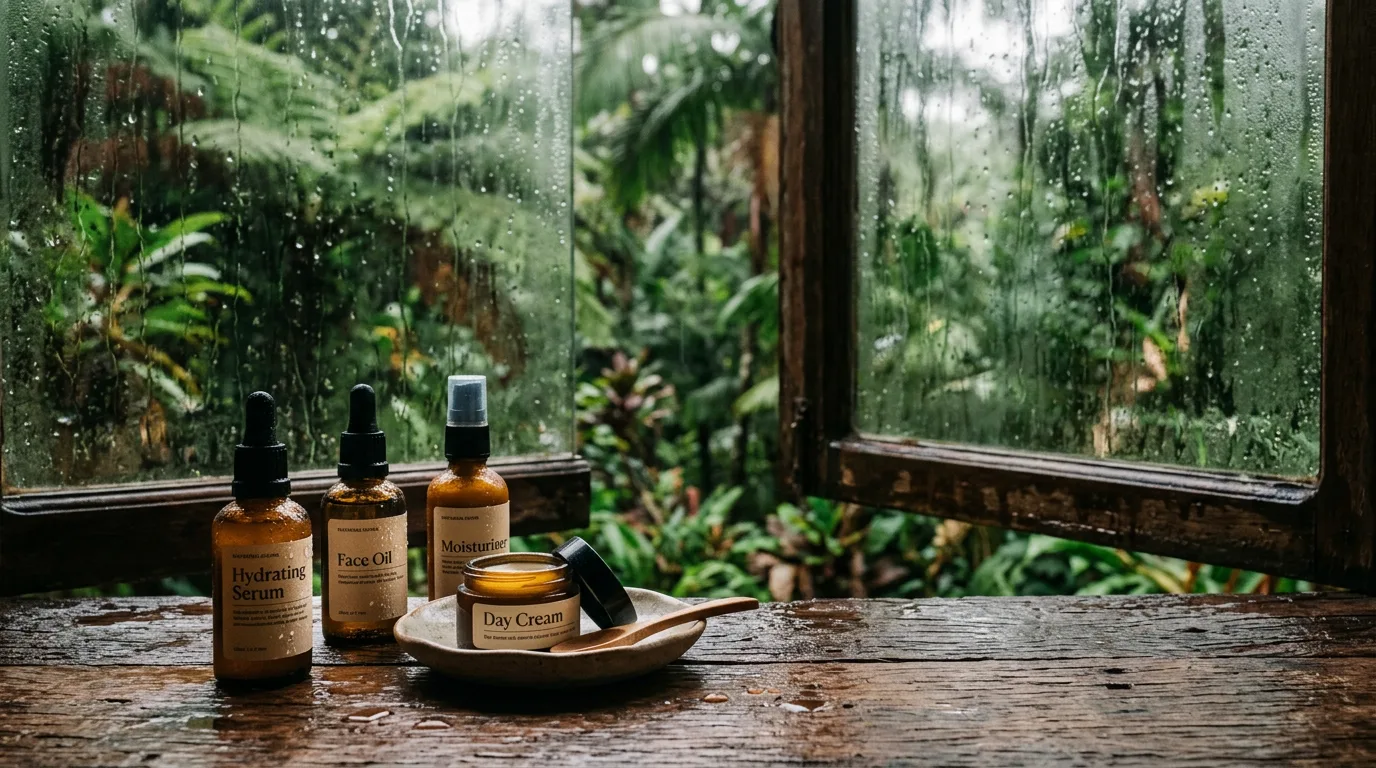
How Heat and Humidity Affect Your Skin
Warm, humid air triggers a chain of physiological responses that most skincare routines are not designed to handle. Sebaceous glands increase oil output by 10-15% for every 1°C rise in skin surface temperature. Sweat glands ramp up to cool the body, depositing salt, urea, and lactic acid onto the skin surface. These two processes — excess sebum and constant perspiration — mix into a film that clogs pores, destabilizes sunscreen, and creates an ideal breeding ground for acne-causing bacteria.
The moisture barrier faces a different problem in humidity than in cold weather. In winter, the barrier loses water to dry air. In humid heat, the barrier stays hydrated but becomes congested. Sweat trapped under heavy products creates miliaria (heat rash) and closed comedones. The lipid-rich creams and occlusive oils that protect skin in January become the primary source of breakouts in July. The fix is not stripping moisture — it is switching the delivery format from thick emulsions to water-based gels and fluid textures that hydrate without sealing.
UV intensity compounds the challenge. Tropical and subtropical regions receive 20-40% more UV radiation than temperate zones at the same time of year. Longer daylight hours mean extended exposure windows. And because people spend more time outdoors in warm weather — walking, eating outside, commuting without enclosed transit — cumulative UV exposure spikes even without deliberate sun-seeking. The sunscreen you apply at 8 AM has partially degraded by 10 AM, and sweat has physically displaced another 30-40% of the protective layer. Reapplication frequency matters more in humid climates than anywhere else.
Keep the same active ingredients you use in cooler months — Vitamin C, hyaluronic acid, niacinamide, retinol. Change only the texture. Cream becomes gel. Balm becomes foam. Thick serum becomes fluid. Your actives still work; the delivery vehicle just needs to match the climate.
Product Picks for Hot and Humid Conditions
Gel-Based Hydration: Vichy Minéral 89
Vichy Minéral 89 is the anchor of a humidity-adapted routine. The hyaluronic acid gel absorbs in under five seconds and leaves zero residue — no tackiness, no film, no greasy layer that traps sweat against the skin. Volcanic mineral water from Vichy provides 15 minerals that strengthen the barrier without adding weight. One pump covers the full face. In humid conditions, this replaces both your hydrating serum and your moisturizer for most skin types. The formula is fragrance-free and works under any SPF without pilling. Oily and combination skin types can use this as their sole hydrating step year-round in tropical climates.
Budget Hydration Layer: The Ordinary Hyaluronic Acid 2% + B5
The Ordinary HA 2% + B5 delivers multi-weight hyaluronic acid at a fraction of prestige pricing. Three molecular weights of HA target different depths of the skin — high molecular weight sits on the surface and pulls moisture from humid air, medium molecular weight hydrates the mid-epidermis, and low molecular weight penetrates deeper. The addition of pro-vitamin B5 (panthenol) supports barrier repair and calms any irritation from heat or sweat. The texture is thinner than most HA serums, making it well-suited for layering in warm weather. Apply to damp skin immediately after cleansing — in humid climates, the ambient moisture gives this formula exactly what it needs to perform at its best.
Clean Beauty Alternative: DIME Beauty Hyaluronic Acid Serum
For those who prioritize clean formulations, DIME Beauty Hyaluronic Acid Serum provides hydration without the ingredient list concerns that bother some buyers. The formula skips parabens, sulfates, phthalates, and synthetic fragrances. The texture falls between The Ordinary (thinner) and traditional cream serums (thicker) — a middle weight that works well in moderate humidity without feeling heavy in extreme tropical conditions. DIME pairs their HA with aloe and vitamin E for antioxidant support. If you live in a subtropical climate with seasonal humidity rather than year-round tropical heat, this formula handles the fluctuation well. Compare it directly against The Ordinary in our side-by-side comparison to see which texture suits your climate better.
On-the-Go Touch-Ups: Tatcha Serum Stick
The Tatcha Serum Stick solves a problem unique to hot climates: midday product breakdown. By 1 PM in humid weather, your morning serum has mixed with sweat and sebum, and your SPF has partially degraded. The solid serum stick format lets you reapply hydration and skin-smoothing actives over makeup without disturbing what is underneath. Squalane and Japanese lemon balm in the formula provide antioxidant defense without the liquid mess of a traditional serum. Toss it in a bag, apply in 10 seconds, and continue with your day. The stick format also means no spills in a gym bag or beach tote — a practical advantage that liquid serums cannot match.
Lightweight Vitamin C: La Roche-Posay Vitamin C10 Serum
La Roche-Posay Vitamin C10 pairs 10% pure Vitamin C (ascorbic acid) with salicylic acid in a fluid texture designed for sensitive and combination skin. The concentration is intentionally moderate — high enough for antioxidant protection and brightening, low enough to avoid the irritation that 20% formulas cause on heat-sensitized skin. Salicylic acid in the formula provides a secondary benefit in humid weather: it keeps pores clear by dissolving the sebum and dead cell mixture that accumulates faster in warm conditions. The fluid absorbs quickly and layers well under SPF. For humid climates where your skin is already stressed by heat and UV, a moderate-strength Vitamin C like this outperforms higher concentrations that risk triggering inflammation.
Budget Vitamin C Option: CeraVe Vitamin C Serum
CeraVe Vitamin C Serum uses 10% L-ascorbic acid with ceramides — a combination that provides antioxidant brightening while reinforcing the moisture barrier. The ceramide inclusion matters in humid climates because heat and sweat can weaken barrier integrity over time, leading to increased sensitivity and transepidermal water loss even in moisture-rich environments. The lightweight lotion texture absorbs faster than cream-based Vitamin C products and sits well under sunscreen. At a lower price point than the La Roche-Posay formula, CeraVe represents strong value for anyone building a warm-weather routine on a budget. The trade-off is a slightly less elegant texture — it takes an extra 15-20 seconds to absorb fully compared to the La Roche-Posay fluid.
The 60-second SPF rule: In humid weather, wait 60 seconds between your last skincare step and your sunscreen. This lets the serum underneath form a stable layer so SPF sits on top rather than mixing into it. Mixed layers pill, streak, and lose UV protection. One minute of patience prevents the midday sunscreen failure that plagues most warm-weather routines.
Building a Humid-Climate Routine
The goal is fewer layers, lighter textures, and faster absorption at every step. A four-step morning and three-step evening routine handles 90% of humid-weather skin needs without the congestion that longer routines cause.
- AM Cleanser: Gel or foam cleanser — removes overnight sebum and sweat without leaving a film. Avoid cream cleansers and cleansing balms in humid months; they deposit emollients that mix with daytime sweat.
- AM Serum: One serum only. Vitamin C (La Roche-Posay C10 or CeraVe Vitamin C) for antioxidant defense, OR hyaluronic acid (Vichy Minéral 89) for hydration. Stacking two serums in heat creates pilling and congestion.
- AM SPF: Gel, fluid, or mineral powder formula. Apply generously and wait 60 seconds before leaving the house. Carry a stick SPF for reapplication every 90 minutes outdoors.
- AM Moisturizer (optional): Skip this step entirely if your serum provides enough hydration. In humid conditions, most gel serums hydrate sufficiently on their own. Add a water-gel moisturizer only if your skin feels tight after serum alone — which is unlikely when ambient humidity exceeds 60%.
- PM Cleanser: Double cleanse to remove SPF and accumulated grime. First step: micellar water or gel-oil cleanser (not a rich balm). Second step: gel cleanser. Double cleansing is non-negotiable in humid climates — sunscreen, pollution particles, sweat salt, and sebum form a stubborn cocktail that a single wash cannot fully dissolve.
- PM Treatment: Retinol (2-3 nights per week) or niacinamide serum (nightly). Both help regulate sebum production and prevent the clogged pores that humidity drives. Apply to fully dry skin — residual moisture on the face accelerates retinol penetration and can cause irritation in heat-sensitized skin.
- PM Hydration: The Ordinary HA or DIME HA as your final evening layer. In humid conditions, this single lightweight hydrating step replaces the multi-layer serum-moisturizer-oil routine that cold-weather skincare demands.
Invest in these products if: you live in a tropical or subtropical climate year-round, you travel frequently to warm destinations, or your skin breaks out every summer despite a consistent routine. The lightweight textures and non-comedogenic formulations here are built for conditions where standard prestige skincare fails. Skip if: you live in a dry climate and only experience brief humidity during summer months — your existing routine with minor texture swaps will handle that adequately.
SPF Strategy for Sustained Heat
Sunscreen failure in humid climates follows a predictable pattern. You apply SPF at home, sweat begins within 30 minutes of stepping outside, and the combination of perspiration and sebum creates channels through the sunscreen film. By the two-hour mark, protection is uneven — some areas retain coverage while others, particularly the nose, forehead, and cheekbones (the convex surfaces where sweat pools and runs), have lost 40-60% of their initial protection.
The solution is format diversification. Your morning SPF should be a fluid or gel that bonds to skin and resists the first wave of perspiration. Your reapplication SPF should be a different format — a stick, a powder, or a cushion compact — that layers over the morning application without displacing it. Stick SPFs press product onto the skin surface with gentle pressure rather than spreading it with fingers, which disturbs the existing layers underneath. Mineral powder SPFs add a fresh layer of zinc or titanium dioxide that sits on top of everything. Neither format requires you to wash your face and start over.
One counterintuitive finding: water-resistant SPF formulas are more important for humid commuters than for swimmers. Swimming involves periodic full-body immersion, but humid commuting involves two to three hours of continuous low-grade sweating that erodes sunscreen through friction and salt dissolution. A water-resistant SPF rated for 80 minutes maintains its integrity under sweat conditions that would dissolve a non-resistant formula in 45 minutes. Check the label — "water-resistant" and "sweat-resistant" are regulated claims that require testing. "Long-lasting" and "all-day protection" are marketing language with no testing requirement.
Pore Management in Warm Weather
Pores become more visible in humidity because they fill faster. Increased sebum production floods the follicular canal, dead cells accumulate more rapidly in the warm, moist environment, and the mixture oxidizes on contact with air — creating the dark-tipped plugs visible as blackheads. The cycle accelerates because warm skin is more permeable, allowing sebum to reach the surface more quickly than in cold conditions where the lipid layer is slower-moving.
Salicylic acid (BHA) at 1-2% concentration is the most effective pore-clearing ingredient for humid climates. Unlike glycolic acid (AHA), which works on the skin surface, salicylic acid is oil-soluble — it penetrates into the pore and dissolves the sebum-dead cell mixture from the inside. In humid conditions, use BHA two to three times per week in the evening after cleansing. Apply to dry skin, wait 20 minutes, then follow with your hydrating serum. The wait time allows the acid pH to work before being neutralized by the next product layer.
Clay masks provide supplemental pore control without daily commitment. A kaolin or bentonite mask applied once weekly absorbs excess sebum from the pore surface and provides a temporary tightening effect. In humid climates, the mask has an additional practical benefit: the clay film absorbs the mineral salts deposited by sweat, which can cause irritation and dullness when left on the skin. Apply for 10-15 minutes (not until fully dry — over-drying strips the barrier), rinse with lukewarm water, and follow with HA serum. The next morning, pores appear smaller and skin tone looks more even.
The Air Conditioning Paradox
Living in a humid climate does not mean your skin stays humid all day. Most people in tropical and subtropical regions spend 8-12 hours in air-conditioned environments — offices, malls, transit, and homes. Air conditioning drops indoor humidity to 30-45%, creating the same dehydrating conditions that cold winter air produces in temperate climates. Your skin oscillates between humid outdoor air and dry indoor air multiple times per day, and each transition stresses the moisture barrier.
This oscillation explains why people in humid climates still experience dehydration. The face feels oily outdoors and tight indoors. Products applied for outdoor conditions feel insufficient inside, and products applied for indoor comfort feel heavy outside. The solution is choosing products that perform adequately in both environments rather than optimizing for one extreme. Gel-based HA serums like Vichy Minéral 89 handle this dual environment well — in humid outdoor air, the HA draws moisture from the atmosphere; in dry indoor air, the gel vehicle provides enough residual hydration to prevent tightness without adding the occlusive weight that causes congestion when you step back outside.
A desktop humidifier at your office workspace addresses the indoor half of the equation. Maintaining 45-55% humidity in your immediate workspace gives HA-based products consistent atmospheric moisture to work with, reducing the rollercoaster effect of moving between climate extremes. Portable USB humidifiers that fit on a desk cost less than a single prestige serum and make every hydrating product in your routine work measurably harder.
Sweat, Makeup, and Midday Rescue
The traditional advice to blot oil and press powder over it works in moderate conditions. In true humidity — dew points above 70°F, skin temperature elevated, visible perspiration on the forehead and upper lip — blotting removes the top layer of oil and sweat but does not address the product breakdown underneath. Your sunscreen has migrated, your primer has dissolved, and pressing powder over the mess just creates a cakey layer over compromised skin.
A better midday rescue in three steps. First, blot with oil-absorbing sheets to remove the surface mixture of sweat, sebum, and degraded product. Second, apply the Tatcha Serum Stick or a similar solid serum to re-deposit hydrating actives directly onto the skin — the solid format does not disturb remaining makeup the way liquid serums would. Third, apply stick SPF over everything to restore UV protection. This three-step process takes under 60 seconds and addresses all three failures (hydration loss, barrier disruption, SPF degradation) without requiring a full re-application of your morning routine.
For those who wear full makeup in humid climates, setting spray is more effective than setting powder. Powder absorbs oil initially but becomes saturated within two hours, creating a heavy, cakey appearance as it mixes with ongoing sebum production. Setting sprays formulated with film-forming polymers create a flexible mesh over makeup that allows moisture to escape (preventing the trapped-sweat congestion that causes breakouts) while holding pigment in place. Apply two passes of setting spray after makeup is complete and before leaving an air-conditioned environment. The protection lasts roughly four hours — longer than any powder finish.
Night Routine Adjustments for Warm Climates
Your evening routine in humid weather should be shorter and lighter than your winter routine. The goal shifts from barrier repair and moisture sealing (winter priorities) to pore clearance and lightweight hydration. Three products maximum: cleanser, treatment, hydrating serum.
Skip the facial oil. In cold, dry climates, a facial oil as the final PM step seals moisture against dehydrating indoor air. In humid conditions, the same oil creates an occlusive layer that traps sweat and sebum produced during sleep. Most people sweat lightly during the night in warm climates — even with air conditioning, skin temperature stays elevated compared to winter months. A layer of oil over that low-grade perspiration is a recipe for morning congestion and the gradual development of closed comedones along the jawline and temples.
Sheet masks are another category to reconsider in humid conditions. The prolonged occlusion of a sheet mask (15-25 minutes of sealed contact) in warm weather pushes ingredients into already-permeable, heat-expanded skin. Sensitive skin types may experience irritation or redness that does not occur when using the same mask in cooler months. If you enjoy sheet masks, use them in an air-conditioned room and limit application time to 10 minutes. Remove the mask, let skin breathe for 5 minutes, then apply your lightweight serum.
When to Transition Your Routine
Climate-based routine transitions are less abrupt than seasonal ones in temperate regions. If you live in a consistently tropical climate, your humid-weather routine is your year-round routine. If you live in a subtropical zone with distinct seasons — warm, humid summers and mild, drier winters — plan two transitions per year.
Switch to your lightweight humid-weather routine when the average dew point exceeds 60°F (15°C) for a consecutive week. Dew point is a better trigger than temperature or relative humidity because it directly measures atmospheric moisture content. A 90°F day with 30% relative humidity (dry heat) does not require the same routine adjustments as an 80°F day with 75% relative humidity (tropical conditions). Most weather apps display dew point, and any reading above 65°F means your cream moisturizer and facial oil should stay in the cabinet.
For travel between climates, pack products for your destination's humidity, not your origin's. Flying from Seattle to Miami in January means switching from your winter barrier-repair routine to humidity-adapted products on the plane — not after you arrive and your skin has already reacted. Bring travel sizes of gel cleanser, lightweight serum, and fluid SPF. Leave the rich cream and cleansing balm at home. Your skin adapts to a new humidity level within 48-72 hours, but the breakouts caused by wearing winter products in tropical heat take two weeks to resolve.
Common Questions About Humid-Weather Skincare
Do I still need moisturizer in humid weather?
Yes, but switch the format. A gel or water-cream replaces your standard moisturizer. Humidity adds atmospheric moisture but does not hydrate the deeper cell layers where transepidermal water loss originates. Skin still loses water through evaporation — especially under air conditioning, which strips indoor humidity to 30-40% even in tropical cities. A lightweight moisturizer with hyaluronic acid replenishes that water loss without adding the occlusive film that turns greasy in heat.
Why does my sunscreen pill and slide off in humidity?
Two common causes. First, layering too many products underneath creates a slippery base that prevents the SPF film from adhering. In humid weather, reduce your morning routine to cleanser, one serum, and SPF — skip the moisturizer if your serum hydrates sufficiently. Second, some chemical sunscreen filters (avobenzone, homosalate) break down faster in heat and reapply poorly over existing layers. Mineral SPFs with zinc oxide grip skin more effectively and resist humidity-driven migration.
Should I exfoliate more often in humid climates?
Slightly more, but not aggressively. Humidity increases sweat and sebum production, which accelerates dead cell buildup in pore openings. Adding one extra BHA (salicylic acid) session per week — going from once weekly to twice — helps keep pores clear without damaging the barrier. Physical scrubs create micro-tears that trap bacteria in the warm, moist environment. Stick to chemical exfoliation in hot weather.
Is hyaluronic acid better or worse in humidity?
Better — and this is the one climate where HA performs at its absolute peak. Hyaluronic acid is a humectant that draws moisture from its environment. In dry climates, it can pull water from deeper skin layers if atmospheric moisture is insufficient. In humid conditions, there is abundant moisture in the air for HA to grab and hold against the skin surface. Apply HA serum to damp skin in humid weather and it works exactly as the marketing promises.
How often should I reapply SPF in hot weather?
Every 90 minutes of outdoor exposure — not every two hours. The standard two-hour guideline assumes moderate conditions. Heat increases sweating, which physically washes sunscreen off the skin surface faster. Sweat also changes skin pH, which can destabilize chemical UV filters. If you are actively sweating (walking, exercising, sitting at an outdoor restaurant), reapply at 90-minute intervals. Carry a stick or powder SPF for touch-ups over makeup.
Can I skip serums entirely in hot and humid weather?
You can reduce the number but should not eliminate them. One well-chosen serum — either a Vitamin C for antioxidant protection or a hyaluronic acid for hydration — still provides measurable benefits even in humid conditions. The key is switching from oil-based or cream-textured serums to water-based gels that absorb in seconds. A single lightweight serum adds 10 seconds to your routine and prevents the oxidative damage that UV and pollution create in warm-weather months.
Get Luxury Skincare Picks Delivered
One email per week. Honest reviews, no spam.
No spam. Unsubscribe anytime.
Ready to Buy? Start Here
Based on this guide, our #1 recommendation:
Vichy Minéral 89 Best all-around serum for humid climates — gel texture, zero residue, works in both outdoor heat and air-conditioned interiors Read Full Review →Can't Decide? Compare Side by Side
Watch: Marlena Stell breaks down the Luxury Skincare for Humid Climates (928K views)
