What Is Retinol? A Science-Based Guide
Retinol is the most studied anti-aging ingredient in dermatology. Decades of published research confirm it stimulates collagen production, accelerates cell turnover, fades hyperpigmentation, and improves skin texture. But "retinol" has become a catch-all term for an entire family of compounds that work differently. This guide separates science from marketing and explains how retinoids work at the cellular level.
The Retinoid Family Tree
Retinoids are Vitamin A derivatives. Your skin can only use one form: retinoic acid (also called tretinoin). Every other retinoid must be converted into retinoic acid by enzymes in your skin before it does anything. The number of conversion steps determines both potency and irritation.
The confusion starts with marketing. Brands label everything from retinyl palmitate to pure retinaldehyde as "retinol" on the front of the package. These are not the same ingredient, and the performance gap between the weakest and strongest over-the-counter retinoid is enormous. Understanding the family tree below saves you from paying premium prices for forms that barely move the needle.
- Retinyl palmitate — three conversion steps. The weakest over-the-counter retinoid. Found in many "anti-aging" moisturizers but produces minimal visible results. Mostly a marketing ingredient.
- Retinol — two conversion steps. The most common over-the-counter retinoid. Effective with consistent use, published results typically visible at 8-12 weeks. CeraVe Retinol Serum and La Roche-Posay Retinol B3 use this form.
- Retinaldehyde (retinal) — one conversion step. Up to 11x more potent than retinol in published comparisons. Medik8 Crystal Retinal uses this form with encapsulated delivery to manage the increased potency.
- Tretinoin (retinoic acid) — zero conversion steps. Prescription only. The gold standard in clinical dermatology. Fastest results, most irritation potential.
- Adapalene — synthetic retinoid, available over-the-counter at 0.1%. Originally designed for acne but also stimulates collagen. Differin Gel made this accessible without a prescription.
Each conversion step loses potency. When retinol converts to retinaldehyde, only a fraction becomes active. When retinaldehyde converts to retinoic acid, another fraction is lost. Published estimates suggest only about 5-10% of applied retinol reaches the active retinoic acid form. This is why concentration matters — 0.5% retinol delivers far less active ingredient than 0.5% retinaldehyde.
How Retinoids Work Inside Your Skin
Once converted to retinoic acid, the molecule binds to retinoid receptors (RARs and RXRs) inside skin cells. This binding triggers gene expression changes that produce four measurable effects.
Collagen stimulation. Retinoic acid upregulates collagen I and collagen III gene expression in fibroblasts. Published studies show increased collagen density in the dermis after 12 weeks of consistent use. This is the primary anti-aging mechanism — rebuilding the structural protein that gives skin its firmness.
Accelerated cell turnover. Normal epidermal turnover takes 28-40 days (longer with age). Retinoids speed this cycle to approximately 14-21 days, pushing fresh cells to the surface faster. The visible result: smoother texture, fewer visible pores, and a brighter complexion.
Melanin regulation. Faster turnover disperses melanin deposits more quickly, fading dark spots and evening skin tone. Retinoids also inhibit tyrosinase, the enzyme that drives melanin production.
Sebum normalization. Retinoids reduce sebaceous gland activity, decreasing oil production over time. This is why dermatologists prescribe tretinoin for acne — it addresses both clogged pores and excess oil.
These four mechanisms operate simultaneously, which is what makes retinoids unique among skincare actives. Most ingredients do one thing well — hyaluronic acid hydrates, niacinamide calms, vitamin C brightens. Retinoids work across multiple biological pathways at once, affecting everything from gene expression in fibroblasts to melanocyte behavior in the epidermis. No other over-the-counter ingredient has this breadth of action backed by this volume of clinical data. A 2006 meta-analysis in the Archives of Dermatology reviewed 12 randomized controlled trials and confirmed measurable improvements in wrinkle depth, skin roughness, and pigmentation across every study — a consistency rare in cosmetic ingredient research.
Retinol Concentrations: What the Numbers Mean
Over-the-counter retinol products range from 0.01% to 1.0%. The percentage matters, but formulation matters more.
- 0.01-0.03%: Minimal effective dose. Some published evidence of benefit, but results take 6+ months. Common in "retinol-infused" moisturizers that prioritize tolerance over efficacy.
- 0.1-0.3%: Beginner range. Visible results in 8-12 weeks with manageable irritation. CeraVe Retinol Serum (encapsulated 0.3%) sits here — strong enough to work, gentle enough to tolerate.
- 0.5%: Intermediate. Noticeable improvement in fine lines and texture within 6-8 weeks. La Roche-Posay Retinol B3 pairs 0.3% retinol with niacinamide for this reason — the B3 calms irritation while retinol works.
- 1.0%: Maximum over-the-counter strength. Fast results but high irritation risk. Only for experienced retinol users with acclimated skin.
Higher is not always better. A well-formulated 0.3% retinol with encapsulated delivery and soothing co-ingredients often outperforms a crude 1.0% formula that causes so much irritation you stop using it. Consistency matters more than concentration — a product you use every night for a year beats a strong product you abandon after two weeks of peeling.
The Retinization Period
When you first start retinol, your skin goes through an adjustment phase called retinization. This is not damage — it is your skin adapting to accelerated turnover. Common experiences during weeks 1-6:
- Dryness and flaking: The outermost layer sheds faster than new cells can replace it. This resolves as cell production speeds up to match.
- Redness: Mild inflammation from increased cellular activity. Should be pink, not angry red. Persistent redness means you need to reduce frequency.
- Temporary breakouts (purging): Pre-existing clogs are pushed to the surface faster. Breakouts appear in your usual problem areas and clear within 4-6 weeks.
- Sensitivity to other products: Your moisture barrier is temporarily compromised. Skip acids, physical exfoliation, and fragrance during retinization.
If retinol irritates even at low frequency, buffer it. Apply moisturizer first, wait 5 minutes for it to absorb, then apply retinol on top. The moisturizer layer slows retinol penetration into skin, reducing irritation while still delivering results. This technique lets even sensitive skin types use retinol consistently.
The purging question is the one that causes the most anxiety. It helps to understand the mechanism: retinol does not create new breakouts. It accelerates the lifecycle of existing clogs — microcomedones that were already forming beneath the surface but would have taken weeks to become visible on their own. Retinol compresses that timeline. If a clogged pore was going to surface in three weeks, retinol brings it up in five days. Once every pre-existing clog has cycled through, the purge ends and breakouts should be less frequent than before you started retinol. The key distinction: purging happens in areas where you normally break out. New breakouts in unusual locations are not purging — they are a reaction, and you should reassess the product.
Building Your Retinol Tolerance
- Weeks 1-2: Apply once per week, in the evening after cleansing. Use a pea-sized amount for the entire face. Follow with moisturizer.
- Weeks 3-4: Increase to twice per week if no persistent irritation. Monitor for redness that lasts beyond the next morning.
- Weeks 5-8: Move to every other night. Your skin should be noticeably smoother by now. Flaking, if present, should be decreasing.
- Weeks 9-12: Nightly use if tolerated. By this point, collagen stimulation is measurable and visible improvements in fine lines and tone should be apparent.
- Month 4+: Maintenance. Consider stepping up to retinaldehyde (Medik8 Crystal Retinal) for enhanced results if retinol feels too gentle.
Retinol and Sun Sensitivity
Retinol does increase photosensitivity. The accelerated cell turnover exposes younger, less UV-hardened cells to sunlight. Published research quantifies this as a modest increase in minimum erythemal dose (MED) — the amount of UV needed to cause redness. The practical consequence: you burn slightly faster.
The solution is simple and non-negotiable. SPF 30+ every morning, reapplied every 2 hours in direct sun. This is required regardless of season. Retinol without sunscreen is counterproductive — you stimulate collagen at night while UV breaks it down during the day.
One detail often overlooked: retinol itself degrades in sunlight. Applying retinol in the morning wastes most of the active ingredient before it can penetrate your skin. Nighttime application is not just about avoiding sun sensitivity — it is about protecting the molecule itself from UV-induced breakdown. Studies measuring retinol stability show that exposure to simulated sunlight degrades up to 80% of the molecule within 15 minutes on the skin surface. Evening application gives retinol hours of darkness to absorb and convert without interference.
Retinol does not make you photosensitive like a medication. The increase is modest — not comparable to photosensitizing drugs like doxycycline. You can still spend time outdoors normally. But skipping SPF while using retinol lets UV undo your progress. Think of sunscreen as the partner that protects what retinol builds.
Retinol and Pregnancy: The Non-Negotiable Rule
Oral retinoids (isotretinoin) are proven teratogens — they cause severe birth defects. Topical retinol has not been studied enough in pregnant women to confirm safety, and the precautionary principle applies. Every dermatologist, every brand, and every medical guideline says the same thing: stop all retinoid products when pregnant or trying to conceive. This includes retinol, retinaldehyde, and adapalene. Resume after breastfeeding ends. Bakuchiol, a plant-based alternative, is considered safe during pregnancy and provides mild retinol-like benefits without the retinoid pathway.
Delivery Technology: Why Formulation Matters as Much as Concentration
Raw retinol dumped into a cream base degrades on the shelf and overwhelms the skin on application. Modern delivery technologies solve both problems. Encapsulation wraps retinol molecules in a protective shell that releases the active ingredient gradually over hours instead of all at once. CeraVe's retinol serum uses this approach — the encapsulated particles deliver retinol slowly, reducing the irritation spike that free retinol causes.
Medik8 takes a different approach with retinaldehyde in a double-layered capsule. The outer layer protects the molecule from air and light during storage. The inner layer controls release speed on the skin. The result: a more potent retinoid (one conversion step closer to retinoic acid) that feels gentler than weaker formulations. This is what you pay for with premium retinoid products — not the molecule itself (retinol is cheap), but the engineering that delivers it effectively.
Time-release formulations also improve long-term compliance. A retinol that stings for 30 seconds is one you will use every night. A retinol that burns for 10 minutes is one you will abandon. The best delivery technology makes the difference between a product that works on paper and one that works in practice.
Storage matters more than most users realize. Retinol degrades when exposed to light, heat, and oxygen — even inside the bottle. Dropper-style packaging exposes the formula to air with every use, while airless pump bottles maintain stability for months longer. Keep any retinol product in a cool, dark drawer rather than a brightly lit bathroom counter. If the formula darkens from clear or pale yellow to amber or brown, potency has dropped and you are applying a weakened product. Some brands now include stability indicators on the packaging — a color-change strip that signals when the active has degraded past the effective threshold. Until that becomes standard, replace opened retinol products after three to four months regardless of how much remains in the bottle. The cost of a half-used bottle is far less than the cost of twelve weeks of ineffective application.
Common Retinol Mistakes
- Starting too strong. A 1.0% retinol on retinol-naive skin causes unnecessary irritation and often leads to abandoning the ingredient entirely. Start at 0.1-0.3%.
- Applying too much. A pea-sized amount covers the entire face. More product means more irritation without more results.
- Mixing with exfoliating acids on the same night. Retinol plus AHA or BHA is a recipe for a compromised moisture barrier. Alternate nights: retinol one evening, acids the next.
- Expecting overnight results. Retinol works through biological remodeling that takes 8-12 weeks to become visible. Collagen synthesis is slow. If you quit at week 4, you miss the payoff.
- Applying to wet skin. Damp skin increases retinol penetration and irritation. Pat your face dry after cleansing, wait 2-3 minutes, then apply retinol to fully dry skin.
- Neglecting the neck and chest. These areas age faster than the face because the skin is thinner and has fewer oil glands. If you apply retinol to your face, extend it to your neck and upper chest. Use a gentler concentration on these areas — they are more prone to irritation than the face.
- Storing near a window or in a steamy bathroom. Light and heat degrade retinol in the bottle the same way they degrade it on skin. An amber bottle stored in a cool drawer retains potency weeks longer than a clear bottle on a bright bathroom shelf.
Watch: Dr. Danny Guo breaks down the What Is Retinol? A Science-Based Guide (276K views)

Frequently Asked Questions
What is the difference between retinol, retinal, and tretinoin?
All three are retinoids, but they differ by how many conversion steps your skin needs before they become active retinoic acid. Retinol requires two conversions (retinol to retinal to retinoic acid), retinal requires one, and tretinoin (prescription) is already retinoic acid. Fewer conversions means faster results but also more irritation potential.
Can I use retinol every night?
Not at first. Start with once or twice per week for the first month. Increase to every other night during month two. Most people can tolerate nightly use by month three. If redness, flaking, or stinging persist beyond 6 weeks, reduce frequency or switch to a lower concentration.
Does retinol make your skin thinner?
The opposite. Short-term retinol may cause peeling that feels like thinning, but long-term use actually thickens the dermis by stimulating collagen production. Published research shows increased epidermal thickness after 12 weeks of consistent retinoid use. The initial peeling is increased cell turnover, not skin thinning.
Should I stop retinol in summer?
No. Retinol works year-round. The concern is UV sensitivity — retinol increases photosensitivity slightly, so SPF 30+ is required every morning regardless of season. Stopping retinol in summer means losing 3-4 months of collagen-building progress. Keep using it at night and wear sunscreen during the day.
At what age should I start using retinol?
Dermatologists generally recommend starting in your mid-to-late 20s for prevention. Collagen production begins declining around age 25 at roughly 1% per year. Starting retinol at 25-28 prevents visible signs of aging before they appear. If you are older and have never used retinol, it is never too late to start — just begin with a gentle formula.
Can I use retinol with Vitamin C?
Yes, but not at the same time. Vitamin C works best at a low pH (around 3.5), while retinol works best at a higher pH (around 5.5-6). Using both simultaneously can reduce the effectiveness of each. The most common approach: Vitamin C in the morning (antioxidant protection during the day), retinol at night (repair and renewal while you sleep).
What is retinol purging and how long does it last?
Purging is the temporary increase in breakouts that occurs when retinol accelerates cell turnover, pushing existing clogged pores to the surface faster. It typically lasts 4-6 weeks. The breakouts appear in your usual problem areas and resolve as the cycle completes. If breakouts appear in new areas or persist beyond 8 weeks, the product may not suit your skin.
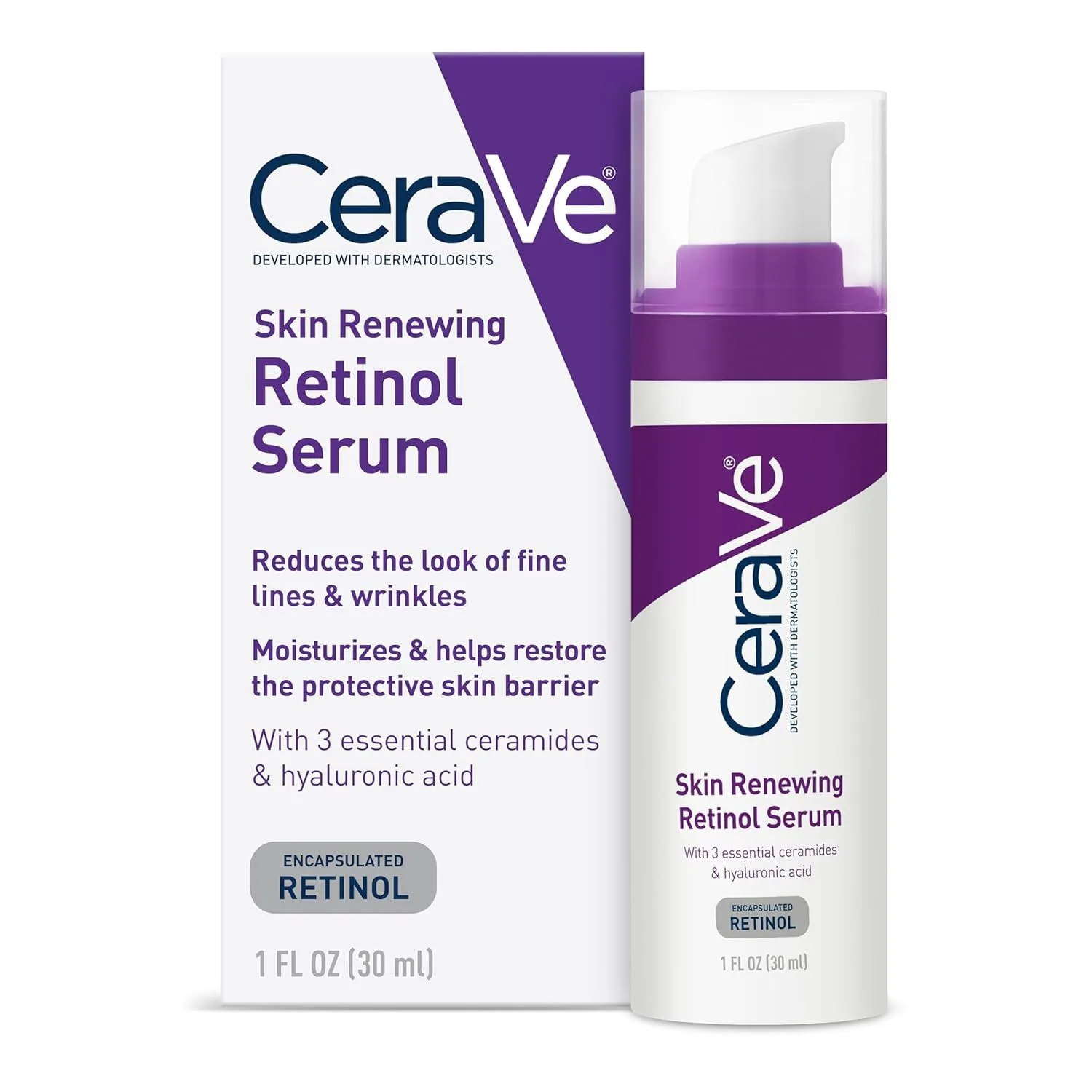
Best starter retinol — encapsulated delivery minimizes irritation
Get Our Top 3 Picks
Get our top 3 picks for your budget — one email, then only updates.
Only when something changes. Unsubscribe anytime.
Ready to Buy? Start Here
Based on this guide, our #1 recommendation:
CeraVe Retinol Serum Best affordable retinol for beginners Read Full Review →