Vitamin C in Skincare: The Complete Guide
Vitamin C is the most studied antioxidant in skincare. Published research confirms it brightens skin, stimulates collagen, fades dark spots, and provides photoprotection sunscreen alone cannot. But the ingredient is notoriously unstable, and not all Vitamin C products are equivalent. The form, concentration, pH, and formulation partners determine whether a serum actually delivers what the science promises.
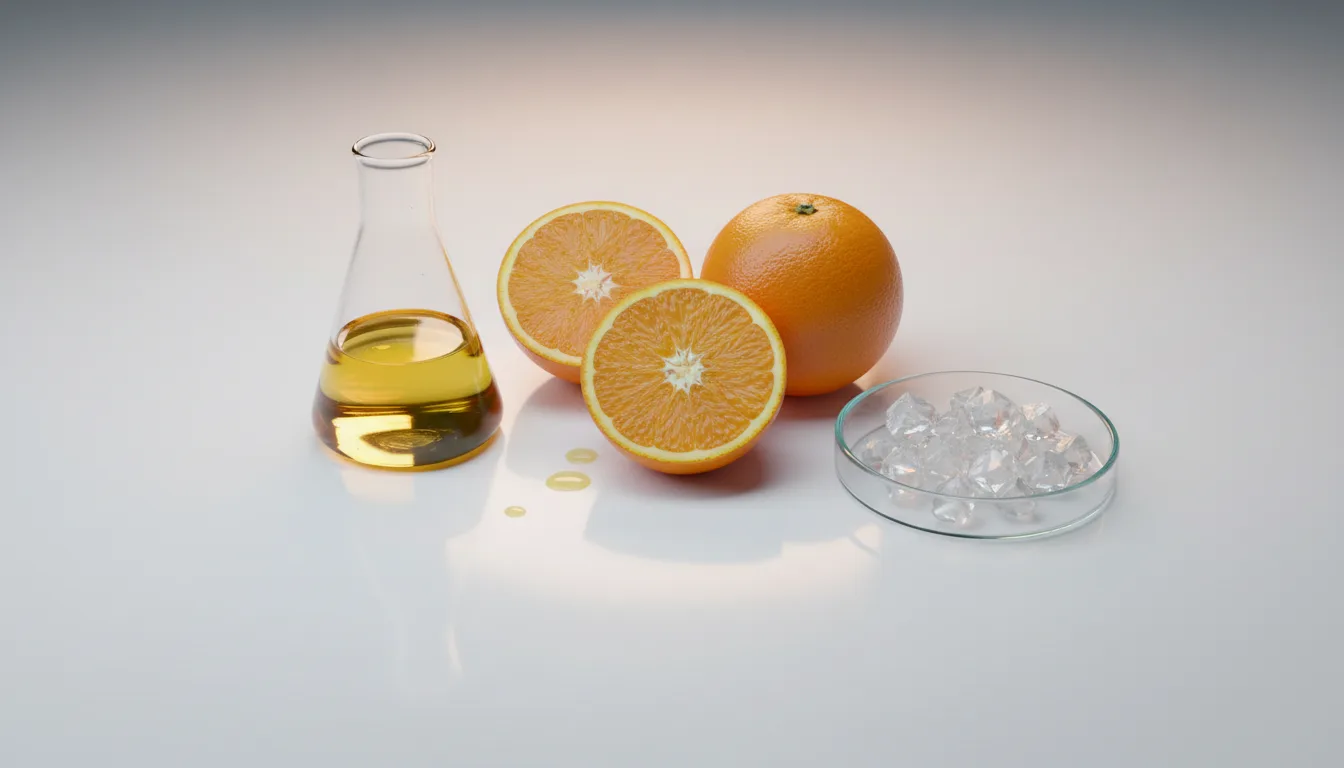
Forms of Vitamin C in Skincare
Multiple forms of Vitamin C appear in skincare products. They differ in stability, skin penetration, potency, and pH requirements. Understanding the differences prevents you from paying prestige prices for an inferior form.
L-Ascorbic Acid (LAA)
The gold standard. L-ascorbic acid is the only form with extensive published clinical evidence for all four Vitamin C benefits (antioxidant protection, collagen stimulation, brightening, photoprotection). It works at a pH of 2.5-3.5 — acidic enough to penetrate the stratum corneum.
The catch: LAA is unstable. It oxidizes when exposed to air, light, and heat, turning orange-brown and losing potency. Formulation matters enormously — a well-stabilized LAA serum (like Drunk Elephant C-Firma with its pod activation) outperforms a poorly packaged one regardless of concentration.
Sodium Ascorbyl Phosphate (SAP)
A stable, water-soluble derivative that converts to ascorbic acid in the skin. Works at a higher pH (neutral to slightly acidic), making it gentler. Published evidence supports antioxidant and anti-acne activity, but less data exists for collagen stimulation compared to LAA. A reasonable choice for sensitive skin that cannot tolerate low-pH LAA serums.
SAP also shows antibacterial activity against Cutibacterium acnes (the bacterium behind inflammatory acne) at concentrations as low as 1%. A 2005 study in the International Journal of Cosmetic Science found that 5% SAP reduced acne lesions by 48% over 12 weeks — a side benefit that LAA does not reliably provide. For acne-prone skin that also wants brightening, SAP may actually be the stronger choice despite being considered the "lesser" form of Vitamin C.
Ascorbyl Tetraisopalmitate
Oil-soluble derivative that penetrates lipid-rich skin layers differently than water-soluble forms. Stable and gentle. Limited published evidence compared to LAA. Common in Japanese and Korean skincare formulations. Better tolerated by dry skin types because of its oil-based delivery.
Ethyl Ascorbic Acid
A newer derivative with improved stability and a neutral pH. Penetrates skin without requiring the acidic environment LAA needs. Emerging research is promising, but the published evidence base is smaller than for LAA. Found in some mid-range serums positioned as "stable Vitamin C" alternatives.
If the ingredient list says "ascorbic acid" or "L-ascorbic acid," you are getting the gold standard form. If it says "sodium ascorbyl phosphate," "ascorbyl glucoside," "ascorbyl tetraisopalmitate," or any other derivative name, you are getting a converted form with different (usually weaker) evidence backing it. Neither is bad — but they are not equivalent. Pay prestige prices only for proven forms.
The C + E + Ferulic Synergy
In 2005, researchers published a study showing that adding Vitamin E (tocopherol) and ferulic acid to a 15% L-ascorbic acid solution doubled its photoprotective capacity. The three ingredients are synergistic — each amplifies the others' antioxidant activity. Ferulic acid also stabilizes Vitamin C, slowing oxidation and extending shelf life.
This triad has become the benchmark for premium Vitamin C serums. Drunk Elephant C-Firma uses 15% LAA with ferulic acid and Vitamin E. Obagi Professional-C uses 20% LAA (without ferulic — its concentration compensates). TruSkin Vitamin C includes Vitamin E and hyaluronic acid at a lower concentration and price point.
The practical difference between a C+E+Ferulic formula and a standalone Vitamin C is most visible in shelf life and long-term stability. A stabilized triad formula typically remains active for 3-4 months after opening, while an unstabilized LAA serum may begin oxidizing within 6-8 weeks. Over a year of use, the cost per effective application often favors the premium formula because you waste less product to oxidation. Budget serums that turn orange after a month end up costing more per dose of active Vitamin C than a pricier serum that stays potent for three months.
The Skinceuticals patent context. Skinceuticals holds the original patent on the 15% LAA + 1% Vitamin E + 0.5% ferulic acid formula. Other brands cannot replicate the exact ratios, so they modify concentrations or add alternative stabilizers. This is why every C+E+Ferulic serum on the market is slightly different — they are all working around the same patent with their own formulation solutions.
pH and Penetration
L-ascorbic acid requires a pH below 3.5 to penetrate the stratum corneum effectively. At higher pH levels, the molecule carries a charge that prevents it from crossing the lipid barrier of outer skin. Published research pinpoints pH 2.5 as optimal for penetration — but also the most irritating.
Most commercial LAA serums are formulated between pH 2.8-3.2 as a compromise. This pH may cause a brief tingling or stinging sensation on application — particularly on compromised or sensitive skin. The sting usually fades within 30 seconds. Persistent burning (beyond 60 seconds) signals that your skin needs a higher-pH derivative instead.
Buffering the pH is one way to reduce irritation without switching to a derivative entirely. Applying a hydrating toner or essence before the Vitamin C serum raises the skin's surface pH slightly, reducing the intensity of the acid contact. Some dermatologists call this the "buffer sandwich" — toner, then Vitamin C, then moisturizer. You sacrifice a small amount of penetration efficiency in exchange for comfort, which is a worthwhile trade for anyone whose skin stings for more than a few seconds on direct application. Consistency matters more than maximum penetration: a serum you use every day at 85% efficiency outperforms one you skip three days a week because it stings.
The Oxidation Problem
Every L-ascorbic acid serum will eventually oxidize. The question is how fast. Factors that accelerate oxidation:
- Air exposure: Every time you open the bottle, oxygen contacts the formula. Dropper bottles are worse than pump dispensers for this reason.
- Light: UV and visible light catalyze oxidation. Amber or opaque bottles are better than clear ones.
- Heat: Warm storage accelerates degradation. Refrigerating your Vitamin C serum can extend its active life by several weeks.
- Water: LAA dissolved in water begins degrading immediately. Anhydrous (water-free) formulas are more stable but less common.
Fresh L-ascorbic acid serum should be clear to very pale yellow. Light yellow is normal and still active. Dark yellow means early oxidation — still usable but less potent. Orange means substantial oxidation — reduced efficacy. Dark orange to brown means most of the active ingredient is gone. Replace it. Check the color every 2-3 weeks by placing a drop on a white surface.
Vitamin C and UV Protection
Vitamin C provides photoprotection through a mechanism different from sunscreen. Sunscreen blocks or absorbs UV photons before they reach skin cells. Vitamin C neutralizes free radicals generated by UV photons that get through. Together, they address UV damage from two angles — which is why published research shows the combination provides more protection than either alone.
This is not theoretical. Studies measuring sunburn markers (MED, erythema response) consistently show reduced damage when Vitamin C is applied under sunscreen versus sunscreen alone. The practical implication: your morning SPF works better with a Vitamin C serum underneath it. Apply Vitamin C first, let it absorb for 2-3 minutes, then apply sunscreen.
One underappreciated aspect of Vitamin C's UV relationship: the ingredient remains active in the skin for 48-72 hours after application. Even if you skip a morning, residual Vitamin C from the previous day still provides partial antioxidant coverage. This depot effect means that consistent daily use builds a higher baseline of protection over time — your skin on day 30 of daily Vitamin C application has more antioxidant capacity than your skin on day 1, even at the same application amount. Missing a single day is not a reset to zero.
Common Mistakes With Vitamin C
Applying to dry skin. Vitamin C serums absorb better on slightly damp skin. The residual moisture from cleansing helps distribute the serum evenly across the face. Applying to completely dry skin leads to patchy distribution — some areas get a concentrated dose while others barely get coverage. Pat your face until damp, not dry, then apply immediately.
Storing in the bathroom. The bathroom is the worst place for a Vitamin C serum. Heat from showers, humidity, and light exposure all accelerate oxidation. Store your serum in a bedroom drawer or, better yet, the refrigerator. The cold temperature slows oxidation measurably — an LAA serum stored at room temperature loses potency twice as fast as one stored in the fridge.
Mixing Vitamin C with SPF in your palm. Some people mix their Vitamin C serum with sunscreen to save time. This dilutes the Vitamin C concentration below the effective threshold and disrupts the SPF film formation. Both products need full-strength, undiluted application. Apply Vitamin C, wait 2-3 minutes, then apply SPF as a separate layer. The extra two minutes are the difference between a cosmetic ritual and an effective skincare routine.
Expecting instant brightening from derivatives. Sodium ascorbyl phosphate and other derivatives convert to active ascorbic acid gradually in the skin. They work — but on a slower timeline than pure LAA. If you switch from a 15% LAA serum to a 10% SAP serum, expect the same brightness results to take 4-6 weeks longer. The gentleness comes at the cost of speed.
Layering too many antioxidants. A Vitamin C serum plus a niacinamide serum plus a green tea moisturizer plus a resveratrol toner is four antioxidants competing for the same receptors. Your skin cannot process them all simultaneously. Pick one antioxidant serum — Vitamin C is the strongest — and let the other ingredients appear as supporting players in your moisturizer or SPF, not as standalone layers. If you want a multi-product Vitamin C approach, the artnaturals Vitamin C Set coordinates toner, serum, moisturizer, and mask around a single active — a more deliberate way to layer than mixing unrelated antioxidant products.
Realistic Results Timeline
- Days 1-7: Immediate brightness. Vitamin C reflects light differently than untreated skin. The glow is partly optical, partly early antioxidant activity.
- Weeks 2-4: Skin tone begins evening. Recent post-inflammatory marks (from acne or minor sun damage) start fading. Morning dullness decreases.
- Weeks 4-8: Measurable brightening. Compare photos from week 1 to see the cumulative difference. Dark spots from the past 6 months show visible lightening.
- Weeks 8-12: Collagen stimulation becomes noticeable. Skin feels firmer. Fine dehydration lines appear softer. Older dark spots continue fading.
- Month 3+: Full effects established with consistent use. Maintaining daily application preserves and builds on results. Stopping Vitamin C reverses the antioxidant protection (though collagen gains persist longer).
Patience is the hardest part. The gradual nature of Vitamin C's results means many people switch products at week 3 because they expect dramatic overnight change. The comparison photos taken weeks apart are the reality check — the daily mirror lies because changes accumulate too slowly to notice in real time. Commit to one Vitamin C serum for a full 8-week cycle before evaluating.
Age and existing skin damage also affect the timeline. Younger skin with mild discoloration responds faster — sometimes visible improvement within two weeks. Deeper pigmentation from years of unprotected sun exposure requires longer treatment, often 12 weeks or more. Hormonal melasma, in particular, resists Vitamin C monotherapy. For stubborn dark patches, Vitamin C works best as part of a combination approach with niacinamide, alpha arbutin, or a prescription like hydroquinone. Vitamin C alone is a maintenance tool for melasma, not a standalone solution. Pairing it with a dedicated retinol product can accelerate turnover of pigmented cells, but introduce one active at a time to avoid barrier damage.
Photography tip for tracking results. Take a photo on day 1 in natural morning light, no makeup, same angle and distance. Repeat every 2 weeks. Dark spots and overall brightness are difficult to notice day-to-day because changes are gradual. Side-by-side photos 4 weeks apart make the difference obvious.
Watch: The Budget Dermatologist breaks down the Vitamin C in Skincare: The Complete Guide (106K views)
Frequently Asked Questions
Why does my Vitamin C serum turn orange?
Oxidation. L-ascorbic acid reacts with air and light, converting to dehydroascorbic acid (yellow-brown). An oxidized serum has lost most of its potency. If your Vitamin C has turned dark orange or brown, replace it. To slow oxidation: store in a dark, cool place, close the cap immediately after use, and choose products with opaque packaging. Some brands (Drunk Elephant C-Firma) use pod-activation to prevent oxidation until first use.
What concentration of Vitamin C is most effective?
Published research shows skin saturation occurs at 20% L-ascorbic acid. Below 10%, results are modest. Between 15-20%, brightening and collagen stimulation are measurable within 2-4 weeks. Above 20% provides no additional benefit but increases irritation risk. Most dermatologists recommend 15-20% for visible results without unnecessary sensitization.
Can I use Vitamin C every day?
Yes. Vitamin C is safe for daily use. Apply every morning after cleansing, before moisturizer and SPF. Daily application provides continuous antioxidant protection against UV-generated free radicals. Unlike retinol, Vitamin C does not require a gradual introduction period — though sensitive skin may start every other day for the first week.
Does Vitamin C cause breakouts?
Pure L-ascorbic acid is water-based and non-comedogenic. Breakouts from Vitamin C products usually come from the base formula (oils, silicones, or fatty acids), not the Vitamin C itself. If you break out from a Vitamin C serum, try a different formulation with a simpler base. TruSkin Vitamin C and Obagi Professional-C have clean, minimal formulas less likely to cause congestion.
Should I use Vitamin C in the morning or at night?
Morning is optimal. Vitamin C provides antioxidant protection against UV-generated free radicals and environmental pollution. Applied before SPF, it adds a layer of photoprotection that sunscreen alone does not provide. Using it at night is not harmful, but you miss the daytime protective benefit — and nighttime is when retinol (which pairs poorly with C in the same step) should take priority.
Is Vitamin C serum worth the high price for premium brands?
It depends on what you are paying for. The active ingredient (L-ascorbic acid) is inexpensive. What premium brands offer is formulation stability (preventing oxidation), delivery technology (penetration enhancers), and synergistic combinations (ferulic acid + Vitamin E). Drunk Elephant C-Firma solves oxidation with a pod system. Obagi Professional-C uses a proven formula at clinical strength. Budget options like TruSkin work but oxidize faster.
Can Vitamin C replace sunscreen?
Absolutely not. Vitamin C neutralizes some free radicals generated by UV exposure, but it does not block UV rays. Published research shows Vitamin C combined with SPF provides roughly 4x more photoprotection than SPF alone — but the SPF is doing the heavy lifting. Vitamin C is the supplement, not the substitute. SPF 30+ is non-negotiable regardless of how much Vitamin C you apply.
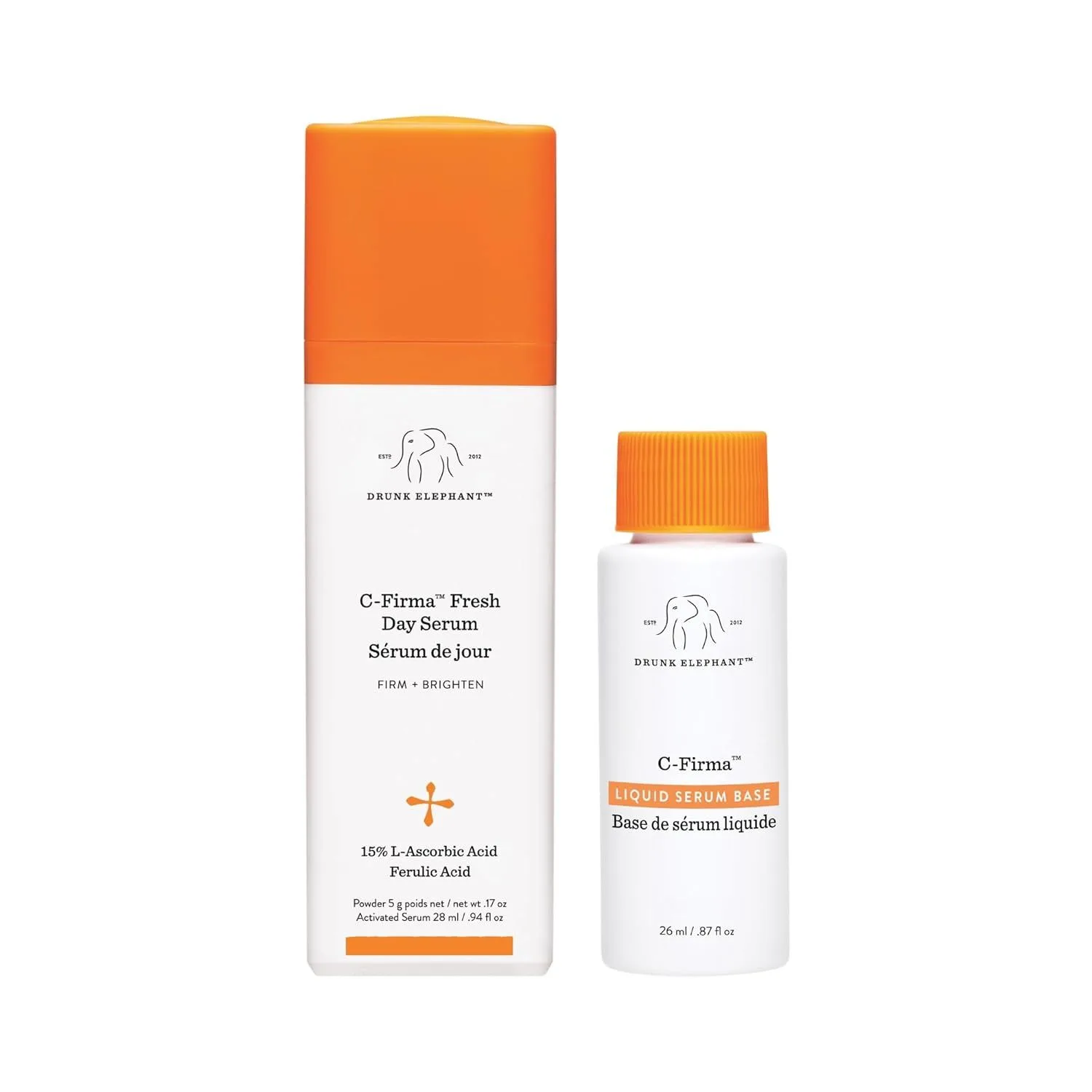
Best stabilized Vitamin C — chronopeptide technology prevents oxidation
Get Our Top 3 Picks
Get our top 3 picks for your budget — one email, then only updates.
Only when something changes. Unsubscribe anytime.
Ready to Buy? Start Here
Based on this guide, our #1 recommendation:
Drunk Elephant C-Firma Best freshness-guaranteed potent Vitamin C Read Full Review →