Vitamin C vs Tranexamic Acid for Dark Spots
Vitamin C and tranexamic acid both target dark spots, but through entirely different biological mechanisms. One is an antioxidant that blocks melanin production at the enzyme level. The other is an anti-inflammatory that interrupts the signaling cascade that triggers melanin overproduction. Choosing between them — or combining them — depends on what is causing your hyperpigmentation in the first place.
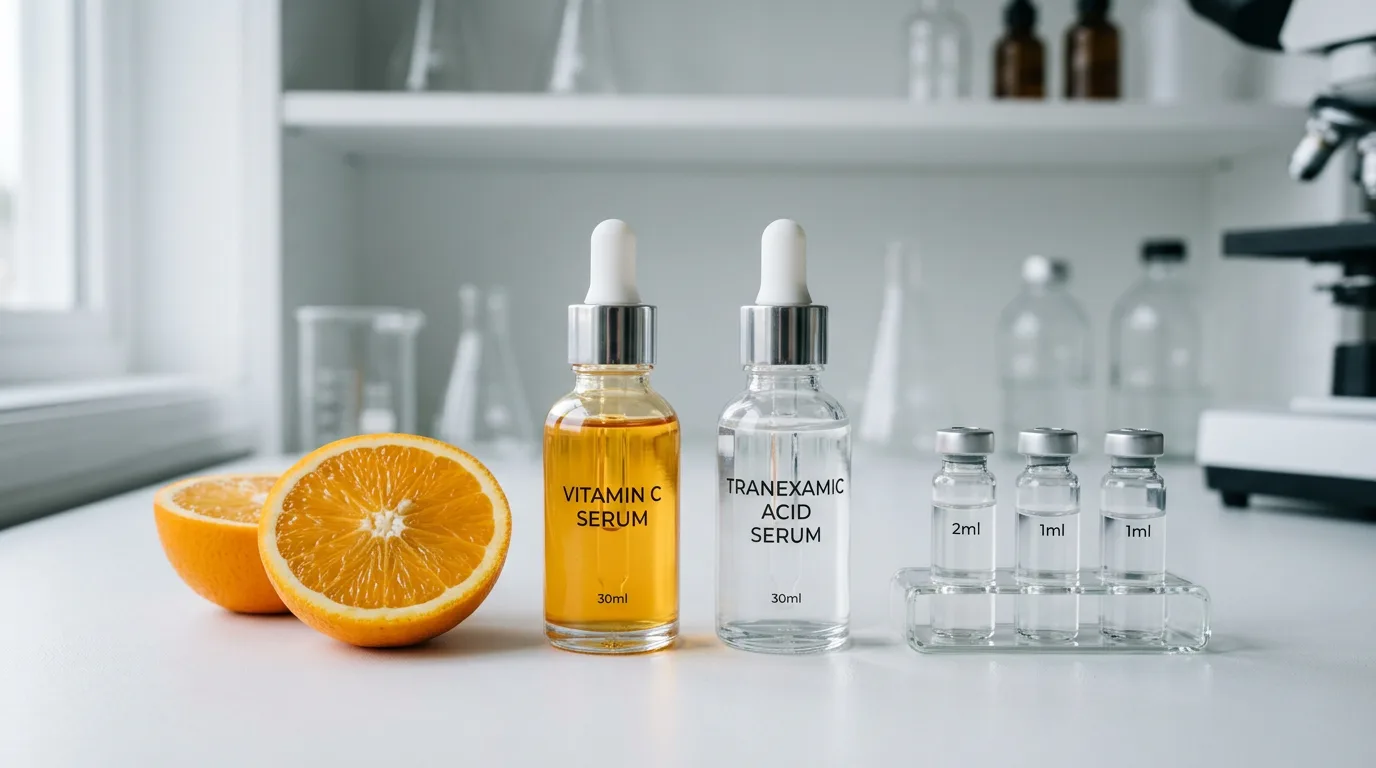
Two Pathways to the Same Goal
Dark spots form when melanocytes produce excess melanin and deposit it unevenly in the epidermis. This happens through multiple triggers — UV exposure, hormonal changes, inflammation from acne or injury, or a combination of all three. The trigger determines which ingredient addresses the root cause more effectively.
Vitamin C (specifically L-ascorbic acid, the most studied form) works by inhibiting tyrosinase — the enzyme that catalyzes melanin synthesis inside melanocytes. Block tyrosinase and you slow down melanin production at the source. This makes vitamin C most effective against UV-induced pigmentation, where ongoing sun exposure keeps driving tyrosinase activity. Products like Drunk Elephant C-Firma deliver L-ascorbic acid at 15% concentration specifically for this purpose.
Tranexamic acid works upstream of tyrosinase. It blocks plasmin, a protease involved in the inflammatory cascade that tells melanocytes to ramp up production. When skin is inflamed — from acne, eczema, irritation, or hormonal fluctuation — plasmin signals trigger melanin overproduction as a protective response. Tranexamic acid intercepts that signal before it reaches the melanocyte. This makes it particularly effective against post-inflammatory hyperpigmentation (PIH) and melasma, where inflammation is the primary driver.
Look at where your dark spots appear. Spots on sun-exposed areas (cheeks, forehead, nose) with clear edges are typically UV-driven — vitamin C is the stronger choice. Spots that follow acne, eczema flares, or appear in symmetrical patches across the face (especially the upper lip and jawline) suggest inflammatory or hormonal triggers — tranexamic acid targets the root cause more directly.
Vitamin C: Strengths and Limitations
L-ascorbic acid has the deepest evidence base of any topical brightening ingredient. Decades of published research confirm its tyrosinase inhibition, collagen stimulation, and antioxidant protection against UV-generated free radicals. At concentrations of 10-20%, it delivers measurable improvements in skin tone within 8-12 weeks.
The limitations are practical, not scientific. L-ascorbic acid requires a low pH (around 3.5) to penetrate the stratum corneum effectively, and that acidity causes stinging and redness on sensitive or reactive skin. It oxidizes when exposed to light and air — a fresh serum is pale or clear, while a degraded one turns amber or brown. Formulation quality varies enormously between brands because stabilizing L-ascorbic acid is a genuine manufacturing challenge.
Derivative forms (ascorbyl glucoside, sodium ascorbyl phosphate, ascorbyl tetraisopalmitate) trade penetration for stability and gentleness. They are easier to formulate and kinder to sensitive skin, but the conversion to active L-ascorbic acid inside the skin is incomplete. A 10% derivative does not equal a 10% L-ascorbic acid serum in receptor-level activity. La Roche-Posay Vitamin C10 uses pure ascorbic acid paired with neurosensine to manage the irritation trade-off — a formulation approach that gives sensitive skin access to the gold-standard form.
For a full breakdown of vitamin C forms, concentrations, and the C+E+ferulic synergy formula, see our vitamin C serums roundup where we rank products by both potency and real-world tolerability.
Tranexamic Acid: The Emerging Standard
Tranexamic acid entered the skincare conversation relatively recently compared to vitamin C, but the clinical evidence has accumulated rapidly. Multiple randomized controlled trials — particularly from Japanese, Korean, and Indian dermatology — demonstrate measurable improvement in melasma severity scores within 8-12 weeks of topical application at 2-5% concentration.
The mechanism is elegant. Plasmin normally breaks down extracellular matrix proteins as part of the wound-healing process, and one of its downstream effects is stimulating melanocyte activity. In conditions like melasma, this plasmin-mediated signaling becomes chronic — melanocytes stay in overdrive even after the initial trigger resolves. Tranexamic acid interrupts this loop by binding to plasminogen before it converts to active plasmin.
Three practical advantages over vitamin C for specific use cases. First, tranexamic acid is pH-neutral and non-irritating at effective concentrations — no stinging, no redness, no adjustment period. Second, it is photostable, meaning it does not degrade with light exposure the way L-ascorbic acid does. Third, it specifically addresses the inflammatory component of hyperpigmentation that vitamin C does not target directly.
Caudalie Vinoperfect Serum represents the brightening-without-vitamin-C approach in our catalog. While it uses viniferine (a grape-derived brightener) rather than tranexamic acid, the philosophy is the same: target pigmentation through non-vitamin-C pathways for skin that reacts poorly to ascorbic acid.
The melasma distinction matters. Melasma is hormonal hyperpigmentation — triggered by pregnancy, birth control, or hormone therapy — and it is notoriously resistant to vitamin C alone. Dermatologists increasingly recommend tranexamic acid as a first-line topical for melasma specifically because it addresses the inflammatory amplification loop that vitamin C cannot reach. If your dark spots worsened during pregnancy or after starting hormonal medication, tranexamic acid should be the priority ingredient.
Concentration and Formulation Details
The effective dose ranges for these two ingredients are well-established in clinical literature, but the skincare industry often blurs the lines between therapeutic and marketing concentrations.
Vitamin C concentration thresholds: Below 8% L-ascorbic acid, published studies show minimal brightening effect — the molecule saturates skin at approximately 20%, meaning higher concentrations add irritation without proportional benefit. The clinical sweet spot is 10-20%, with most dermatologists recommending 15% as the balance point between efficacy and tolerability. CeraVe Vitamin C Serum uses 10% pure ascorbic acid — gentle enough for most skin types while remaining above the minimum effective threshold. At the other end, Obagi Professional-C at 20% delivers maximum saturation for aggressive brightening protocols.
Tranexamic acid concentration thresholds: Clinical trials typically use 2-5% topical concentration. Lower than 2% shows inconsistent results across studies. At 3%, the most commonly studied concentration, measurable reduction in melanin index appears within 8 weeks. Going above 5% does not show additional benefit in published dose-response data. Unlike vitamin C, tranexamic acid does not require pH optimization — it works at the skin's natural pH range of 4.5-6.5, which is why it causes virtually no irritation even at effective concentrations.
A critical formulation difference: vitamin C stability depends heavily on packaging and co-ingredients. L-ascorbic acid paired with vitamin E and ferulic acid (the Skinceuticals C E Ferulic formula, widely replicated) shows 4-8x improved stability and penetration in published testing. Without those co-ingredients, the same concentration of L-ascorbic acid performs measurably worse. Tranexamic acid has no such dependency — it is stable in simple formulations, complex ones, and everything in between.
Tranexamic acid appears on ingredient lists as "tranexamic acid" — no aliases, no derivative forms, no marketing names to decode. This is refreshingly simple compared to vitamin C, which hides behind at least six different chemical names (ascorbic acid, ascorbyl glucoside, sodium ascorbyl phosphate, ascorbyl tetraisopalmitate, 3-O-ethyl ascorbic acid, ascorbyl palmitate). When evaluating a tranexamic acid product, the only question is concentration — and most reputable brands state it clearly.
Head-to-Head: When Each Wins
Neither ingredient is universally superior. Their effectiveness depends on the type, cause, and location of hyperpigmentation.
- Sun spots and photoaging: Vitamin C wins. Tyrosinase inhibition directly counters UV-driven melanin production, and the antioxidant activity prevents new free radical damage from creating more spots. This is vitamin C's strongest clinical indication.
- Post-acne dark marks (PIH): Tranexamic acid wins. The inflammatory cascade from acne breakouts drives PIH through plasmin-mediated signaling — exactly the pathway tranexamic acid blocks. Vitamin C helps but does not address the inflammatory root cause.
- Melasma: Tranexamic acid wins. Published dermatology guidelines from multiple countries now include topical tranexamic acid as a recommended melasma treatment. Vitamin C contributes modest improvement but cannot resolve the hormonal-inflammatory loop alone.
- Overall skin brightening: Vitamin C wins. Beyond spot correction, vitamin C provides whole-face luminosity through antioxidant protection and mild exfoliation at low pH. Tranexamic acid targets spots specifically but does not create the same overall glow.
- Sensitive and reactive skin: Tranexamic acid wins on tolerability. No pH sensitivity, no stinging, no oxidation concerns. For skin that cannot tolerate L-ascorbic acid at effective concentrations, tranexamic acid delivers targeted brightening without the irritation barrier.
The Combination Strategy
Using both ingredients simultaneously is not redundant — it is additive. They work through independent mechanisms with no interference or competition for the same biological pathways.
A practical protocol for combined use: vitamin C serum in the morning (antioxidant protection during UV exposure hours), tranexamic acid at night (anti-inflammatory correction during the skin's repair phase). This sequencing aligns each ingredient with the biological window where it performs best.
If your skin tolerates L-ascorbic acid well, the morning vitamin C also provides photoprotection that amplifies sunscreen effectiveness — a documented synergy where vitamin C neutralizes free radicals that penetrate past SPF filters. Obagi Professional-C Serum at 20% concentration paired with SPF 30+ creates a defense-and-repair framework that addresses pigmentation from both prevention and correction angles simultaneously.
For skin that reacts to L-ascorbic acid, substituting a derivative form in the morning and using tranexamic acid at night still captures the dual-pathway benefit — just with reduced vitamin C potency. The Tatcha Brightening Serum uses a gentler approach to luminosity that can slot into the morning step for reactive skin types.
Products in Our Catalog for Each Pathway
The vitamin C side of this comparison is well-represented. Drunk Elephant C-Firma delivers 15% L-ascorbic acid with ferulic acid and vitamin E — the triple-antioxidant formula that published research shows enhances vitamin C stability and penetration by up to 8x. Our Drunk Elephant vs Obagi comparison breaks down how two premium L-ascorbic acid serums approach the same goal with different concentration and delivery strategies.
TruSkin Vitamin C Serum proves that effective vitamin C does not require a premium price. At a budget-friendly tier, it delivers measurable brightening for users who want to test the ingredient before committing to a prestige formula. See how it stacks up in our TruSkin vs CeraVe Vitamin C comparison.
The tranexamic acid pathway is currently underrepresented in our catalog because most dedicated tranexamic acid serums come from K-beauty brands not yet in our lineup. Caudalie Vinoperfect Serum represents the non-vitamin-C brightening philosophy, and the La Roche-Posay C10 versus Caudalie brightening comparison directly tests the vitamin C approach against an alternative pathway.
The SPF Factor Both Ingredients Share
Regardless of whether you choose vitamin C, tranexamic acid, or both, daily broad-spectrum SPF 30+ is the single most important variable in any brightening protocol. UV exposure triggers melanin production through multiple pathways simultaneously — both the tyrosinase pathway that vitamin C targets and the inflammatory pathway that tranexamic acid addresses. Without SPF, both ingredients are working against an ongoing stimulus rather than resolving existing damage.
This is not theoretical. A 2019 split-face study found that patients using brightening actives with consistent SPF showed 2.5x greater improvement in melanin index scores compared to the same actives without rigorous sun protection. SPF does not just prevent new spots — it creates the biological conditions that allow brightening ingredients to work on existing pigmentation without competing against fresh UV damage every day.
The SPF interaction also differs between the two ingredients. Vitamin C provides additive photoprotection — it neutralizes free radicals that penetrate past sunscreen filters, effectively extending your SPF coverage by 20-30% in published testing. Tranexamic acid has no photoprotective properties. Both benefit from SPF, but vitamin C actively enhances it. This is another reason morning vitamin C paired with sunscreen is a clinically well-supported combination that goes beyond marketing.
Choosing Your Starting Point
If you have sun-driven dark spots and tolerant skin, start with vitamin C. The evidence base is deeper, the product options are broader, and the secondary benefits (antioxidant protection, collagen stimulation) add value beyond brightening alone.
If you have post-inflammatory marks, melasma, or skin that stings with vitamin C, start with tranexamic acid. The tolerability advantage means you will actually use it consistently — and consistency is the single biggest predictor of brightening results regardless of which ingredient you choose.
If you have the budget and routine capacity for both, use both. The combination addresses more pigmentation pathways than either alone, and there is zero risk of negative interaction between them. Morning vitamin C, evening tranexamic acid, daily SPF 30+ — that three-part protocol covers prevention, correction, and protection in one routine. For vitamin C product comparisons at every price tier, our vitamin C serums roundup ranks the options by potency, stability, and skin-type fit.
Frequently Asked Questions
Is vitamin C or tranexamic acid better for dark spots?
It depends on your skin type and the type of hyperpigmentation. Vitamin C (L-ascorbic acid) is an antioxidant that inhibits tyrosinase and prevents new melanin formation — best for sun-induced spots and overall brightening. Tranexamic acid blocks plasmin activity in the inflammatory cascade, making it more effective for post-inflammatory hyperpigmentation and melasma. For stubborn hormonal pigmentation, tranexamic acid has stronger clinical evidence.
Can I use vitamin C and tranexamic acid together?
Yes. They work through completely different mechanisms and do not interfere with each other. Vitamin C blocks melanin production at the enzyme level while tranexamic acid reduces the inflammatory signals that trigger melanin overproduction. Using both creates a two-pathway approach — prevention plus correction. Apply vitamin C in the morning and tranexamic acid at night, or use them in the same routine if the formulations are compatible.
Does tranexamic acid work on all skin tones?
Tranexamic acid is particularly well-studied on Fitzpatrick skin types III-VI, where post-inflammatory hyperpigmentation is more common and more persistent. Multiple clinical trials in Asian and South Asian populations show measurable improvements in melasma and PIH within 8-12 weeks. It is also safe for darker skin tones where hydroquinone carries a risk of paradoxical darkening (ochronosis).
Which is safer for sensitive skin?
Tranexamic acid is generally better tolerated. Vitamin C, particularly L-ascorbic acid at 10-20%, can cause stinging, redness, and irritation on reactive skin because it requires a low pH (around 3.5) to penetrate. Tranexamic acid is pH-neutral and non-irritating at standard concentrations. Sensitive skin types who react to vitamin C often tolerate tranexamic acid without issues.
How long does tranexamic acid take to work?
Published clinical trials show measurable lightening of dark spots within 8-12 weeks of consistent twice-daily use at 2-5% concentration. Full results typically appear at 16-24 weeks. This is comparable to vitamin C timelines, though tranexamic acid may show faster improvement on inflammatory hyperpigmentation specifically.
Is tranexamic acid the same as the blood-clotting drug?
Same molecule, different application. Oral tranexamic acid has been prescribed since the 1960s for heavy menstrual bleeding and surgical hemostasis. Topical tranexamic acid in skincare uses concentrations of 2-5% applied to skin, where it acts locally on melanocyte signaling pathways. The systemic absorption from topical application is negligible — well below the levels that affect clotting. Dermatologists consider topical tranexamic acid safe for cosmetic use.
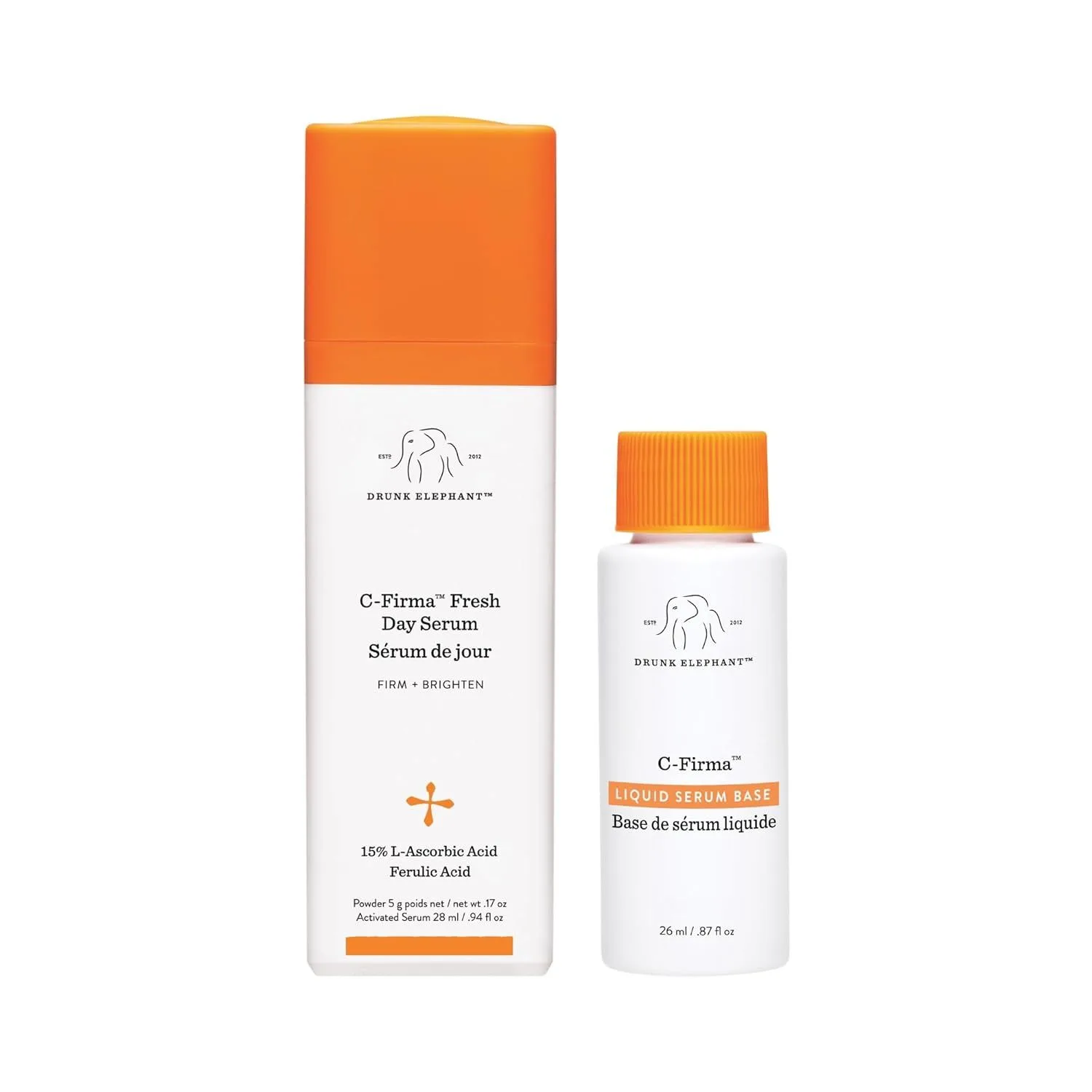
15% L-ascorbic acid with ferulic acid — the gold-standard brightening formula
Get Luxury Skincare Picks Delivered
One email per week. Honest reviews, no spam.
No spam. Unsubscribe anytime.
Watch: Dr Dray breaks down the Vitamin C vs Tranexamic Acid for Dark Spots (163K views)
