Skincare for Men | What Actually Matters
Men's skin is thicker, oilier, and ages on a different timeline than women's. These biological differences change which textures work, which actives matter most, and how to build a routine that a man will actually use. We cover the science first, then the practical steps.
The Biology: How Male Skin Differs
Testosterone drives three measurable differences in male skin. First, thickness: men's dermis is approximately 20-25% thicker than women's, with higher collagen density per square centimeter. This thickness provides structural resilience — men's skin sags and wrinkles later — but it also means products need different textures to penetrate effectively. Thick, heavy creams designed for thinner female skin sit on the surface of male skin rather than absorbing. Lightweight gels, serums, and fluid textures penetrate male skin more efficiently.
Second, sebum production. Men produce 40-70% more sebum due to higher testosterone levels and larger, more active sebaceous glands. This creates the characteristic oily T-zone that most men recognize: forehead, nose, and chin producing visible shine by midday. The upside is that higher sebum acts as a natural moisturizer, meaning men's skin stays hydrated longer without products. The downside is clogged pores, larger visible pore diameter, and a higher baseline rate of acne and blackheads compared to women of the same age.
Third, the shaving factor. Most men shave some portion of their face regularly, which creates a unique skin challenge. Razors remove the stratum corneum (outermost dead skin layer) alongside hair, effectively exfoliating the lower face with every shave. This makes the shaved area thinner and more sensitive than the forehead and cheeks, creating two different skin zones on the same face. Post-shave skin is also temporarily more permeable to active ingredients — a double-edged quality that means serums absorb better but irritants penetrate deeper.
Treat your face as two zones: the forehead and upper cheeks (where you apply full-strength actives) and the jawline and neck (where you apply gentler products or diluted concentrations, especially on shave days). This accounts for the natural exfoliation that shaving provides and prevents the irritation that comes from double-exfoliating the lower face.
Why Most Men Skip Skincare — and Why It Catches Up
Men's thicker skin and higher oil production create a misleading comfort zone in the 20s and early 30s. The skin looks fine without products. No dryness, no visible wrinkles, no apparent damage. This natural resilience leads most men to conclude that skincare is unnecessary — and for daily comfort, they are temporarily right. The problem is that UV damage, collagen degradation, and environmental stress accumulate invisibly beneath the surface.
Then the 40s hit. And the bill comes due.
By the mid-40s, the accumulated damage surfaces rapidly. Collagen density that protected the skin in earlier decades has declined steadily at roughly 1% per year since age 20. Sun exposure without SPF has created a reservoir of damaged cells. The transition from "fine" to "visibly aged" happens faster in men than in women partly because men have no equivalent to the perimenopause collagen crash — instead, they experience a long, slow decline that suddenly crosses a visibility threshold. The man who consistently looked younger than his age at 35 often looks noticeably older than his age at 55, and the gap is almost entirely attributable to decades of zero sun protection.
Building a Routine Men Will Actually Follow
The most effective skincare routine is the one that gets used daily. For men, this means three non-negotiable design principles: minimal products, fast application, and visible results within weeks. Any routine that takes more than three minutes or requires more than four products will be abandoned within a month. Research on habit formation shows that skincare routines with three to four steps have 80%+ adherence rates at 90 days, while routines with six or more steps drop below 40%.
Step 1 — Cleanser (evening, 30 seconds): A gel or foam cleanser removes the day's accumulation of sebum, sunscreen, pollutants, and dead cells. This single step provides the biggest improvement over the baseline of using bar soap or body wash, which are formulated at pH levels too high for facial skin and strip the moisture barrier. Any cleanser designed for facial skin at pH 4.5-6.5 works. For oily skin, the charcoal-based cleanser in the Lumin Smooth Operator Kit targets excess sebum directly.
Step 2 — Moisturizer (morning and evening, 30 seconds each): Despite producing more oil, men's skin loses water faster than women's through trans-epidermal water loss. A lightweight moisturizer with glycerin or hyaluronic acid restores that moisture without adding oil. The MARLOWE Men's Face Kit includes both a daily moisturizer and a separate SPF lotion — the ideal morning combination. For men who want separate AM and PM formulas, the Tiege Hanley Level 1 system provides that split.
Step 3 — SPF (morning only, 30 seconds): Sunscreen is the single most impactful product for preventing visible aging. SPF 30 blocks 97% of UVB rays. SPF 50 blocks 98%. Both are more than adequate for daily use. The key is daily application — incidental sun exposure during commutes, walks, and outdoor lunch breaks accumulates into damage that no retinol or Vitamin C can fully reverse. A moisturizer with built-in SPF reduces this to a single step.
Step 4 (optional) — Active treatment (evening, 30 seconds): After 30-60 days of consistent cleansing, moisturizing, and sun protection, consider adding one treatment serum. Retinol for anti-aging and texture improvement. Vitamin C for brightening and antioxidant protection. Niacinamide for oil control and pore refinement. Choose one — not three — and use it consistently for 12 weeks before evaluating results. The CeraVe Retinol Serum is the most forgiving entry point for retinol beginners.
Sebum, Pores, and the Oil-Control Paradox
Men's sebaceous glands produce roughly twice the sebum volume of women's glands. This excess oil keeps skin naturally moisturized but creates a cycle of problems: enlarged pores, surface shine, clogged follicles, and a higher rate of inflammatory acne. The instinctive response — stripping all oil with harsh cleansers — makes the problem worse. When the skin barrier is depleted of its natural sebum, the glands ramp up production to compensate. The result is skin that feels dry immediately after washing but becomes oily again within an hour or two.
Less stripping. More managing.
The correct approach is oil management, not oil elimination. A gentle cleanser at the right pH removes excess surface sebum without signaling the glands to overproduce. A lightweight, oil-free moisturizer maintains barrier hydration so the glands reduce output naturally. Over four to six weeks of consistent gentle cleansing and moisturizing, most men notice that their T-zone produces less midday shine — not because the glands have fundamentally changed, but because the skin is no longer trapped in a constant state of barrier emergency. Niacinamide at 5% concentration further regulates sebum production and visibly reduces pore diameter over 8-12 weeks of daily use.
Active Ingredients That Matter for Men
Retinol: The most studied anti-aging ingredient in dermatology. Retinol accelerates cell turnover, stimulates collagen production, and reduces fine lines and hyperpigmentation. Men's thicker skin tolerates retinol better than women's skin on average — the denser dermis provides a buffer against the drying and peeling side effects that accompany the first four to six weeks of use. Start at 0.3% concentration, apply every other evening, and increase frequency as tolerance builds.
Vitamin C (L-ascorbic acid): An antioxidant that neutralizes free radical damage from UV exposure and pollution. It also inhibits melanin production, fading dark spots and evening skin tone. For men who spend time outdoors without consistent SPF (which is most men), Vitamin C provides a secondary defense layer. Use it in the morning under SPF for stacked protection. The TruSkin Vitamin C Serum delivers L-ascorbic acid at the budget tier.
SPF filters: Chemical filters (avobenzone, homosalate) absorb UV radiation. Mineral filters (zinc oxide, titanium dioxide) reflect it. Both work. Men historically avoided sunscreen because of white casts and greasy textures — modern formulations have solved both problems. Gel sunscreens and tinted mineral formulas disappear on skin within seconds. The resistance is cultural, not formulation-based, and it is the most expensive mistake a man can make for his skin's long-term appearance.
The collagen timeline: Men lose approximately 1% of their total collagen per year starting at age 20. By age 40, you have lost 20% of the collagen you had at 20. By age 60, 40% is gone. Retinol is the only topical ingredient proven to stimulate new collagen production. Starting retinol at 30 maintains collagen reserves. Starting at 50 slows further loss but cannot rebuild what decades of decline have removed. The math favors early adoption.
The Shaving-Skincare Intersection
Shaving is the one skincare step most men already perform — and it interacts with every other product in the routine. A razor blade removes the stratum corneum alongside hair, creating a freshly exfoliated surface that absorbs products faster but also reacts to irritants more intensely. On shave days, skip any exfoliating scrub or chemical exfoliant — the razor has already done that work. Apply a soothing moisturizer immediately after shaving while the skin is still slightly damp. This locks in hydration during the brief window when the barrier is most permeable.
Electric shavers cause less barrier disruption than blade razors, which means they also provide less exfoliation. Men who use electric shavers benefit more from a separate exfoliating step two to three times weekly. Pre-shave oil applied before an electric shave lifts hairs and reduces friction but does not replace the need for post-shave moisturizing.
Retinol and shaving require timing management. Retinol applied to freshly shaved skin causes stinging, redness, and unnecessary irritation. On shave days, apply retinol only to the unshaved areas — forehead, temples, around the eyes. Reserve full-face retinol application for non-shave evenings. This pacing naturally creates an every-other-day retinol schedule that matches the recommended introduction frequency for beginners. After eight weeks of tolerance building, most men can apply retinol on shave days as well, though starting with diluted concentration on shaved areas remains prudent.
Ingrown hairs are the most common shaving-related skin complaint among men. They occur when a cut hair curls back into the skin, creating an inflammatory bump. Chemical exfoliants containing salicylic acid (a BHA) penetrate into the pore and dissolve the debris trapping the hair. This approach is more effective than physical scrubbing, which can push ingrown hairs deeper. A lightweight hydrating serum like The Ordinary Hyaluronic Acid applied before moisturizer helps maintain the barrier integrity that prevents ingrowns from forming in the first place.
Common Mistakes and How to Avoid Them
Using body wash on the face: Body wash and bar soap are formulated at pH 9-10 for thicker body skin. Facial skin functions optimally at pH 4.5-5.5. Alkaline cleansers disrupt the acid mantle, strip natural oils, and cause the skin to overcompensate with excess sebum production — creating a cycle of dryness followed by oiliness. A dedicated facial cleanser at the correct pH prevents this entirely.
Scrubbing harder instead of smarter: Aggressive physical scrubbing with rough exfoliants — walnut shell, pumice, stiff brushes — causes micro-tears in the skin surface that invite bacteria and inflammation. Men's thicker skin tolerates more exfoliation than women's, but the solution is finer particles applied with moderate pressure, not coarser particles applied with force. Two to three times weekly with a quality scrub produces better results than daily scrubbing with an abrasive product.
Ignoring the neck: The neck ages faster than the face because the skin is thinner, receives more direct sun exposure (especially from driving), and rarely receives any skincare products. Every product you apply to your face — cleanser, moisturizer, SPF, retinol — should extend to the neck and jawline. The neck-face mismatch where a well-maintained face sits above a neglected neck is one of the most visible and avoidable signs of aging in men over 50.
Applying products on dry skin: Damp beats dry. Moisturizers and serums absorb best when applied to slightly damp skin — within 60 seconds of toweling off after cleansing. Damp skin is more permeable, and humectants like glycerin and hyaluronic acid trap the residual surface water rather than pulling moisture from deeper layers. Pat your face with a towel until damp, not bone dry, then apply your products immediately. This single timing adjustment measurably improves the efficacy of every moisturizer and serum you own.
Questions About Men's Skincare
Is men's skin actually different from women's skin?
Yes, measurably. Male skin is approximately 20-25% thicker due to higher collagen density driven by testosterone. Men produce 40-70% more sebum, which means larger pores, more frequent breakouts, and a naturally oilier complexion. Men's skin also has a higher water content but loses moisture faster due to trans-epidermal water loss (TEWL). These differences are hormonal and biological, not cosmetic — they affect which formulation textures and active concentrations work best.
Do men need to use products specifically marketed for men?
No. The active ingredients that improve skin — retinol, Vitamin C, hyaluronic acid, niacinamide, SPF — work identically regardless of who uses them. Men's-labeled products often use the same formulations as standard products with different packaging and fragrance. Buy based on your skin type and concerns, not based on gendered marketing. Men do generally prefer lighter textures and simpler routines, and some men's kits are designed around those preferences.
What is the absolute minimum skincare routine for men?
Two products: a gentle face wash and a moisturizer with SPF. Wash your face every evening to remove the day's oil, dirt, and sunscreen. Apply the SPF moisturizer every morning. This two-step routine takes under 90 seconds and prevents the two biggest sources of skin damage: accumulated grime (which causes breakouts and dullness) and UV exposure (which causes wrinkles, dark spots, and skin cancer). Everything beyond these two steps is refinement.
At what age should men start a skincare routine?
As early as possible, but realistically, most men start in their late 20s to early 30s when they notice the first signs of aging. Starting at 20 with just cleanser and SPF prevents the accumulated UV damage that becomes visible at 40. Starting at 30 with the addition of retinol slows collagen loss that accelerates through that decade. Starting at 40+ is not too late — retinol and Vitamin C produce measurable improvements at any age — but earlier intervention means less damage to reverse.
Does shaving count as exfoliation?
Partially. A razor removes the top layer of dead skin cells along with facial hair, which functions as mild physical exfoliation. This is why freshly shaved skin often looks brighter and smoother than it did before shaving. On shave days, skip any additional exfoliating products — scrubs or chemical exfoliants on freshly shaved skin cause irritation, redness, and micro-abrasions. Reserve your exfoliant for non-shave days, using it two to three times per week.
Why does men's skin age differently than women's?
Men's higher collagen density means their skin maintains structure longer — fine lines appear later. But when male skin does start aging, the decline is steeper. Collagen loss in men is gradual and linear (about 1% per year throughout life), while women experience a sharp collagen drop during perimenopause followed by slower decline. The result: men often look younger than women at 40 but show rapid aging in their 50s as cumulative sun damage, lower collagen reserves, and decades of minimal skincare converge.
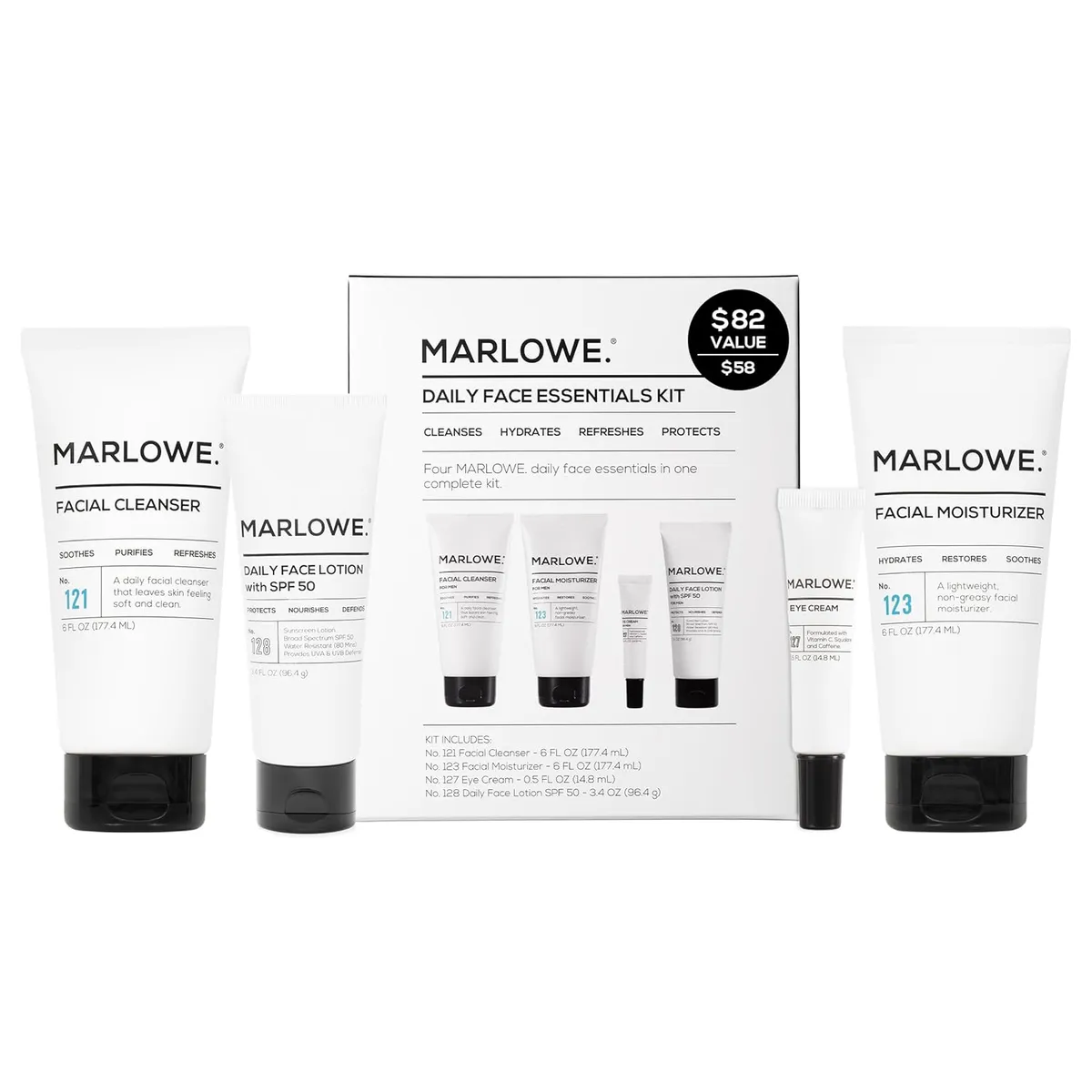
Four full-size products with SPF 50 at the budget tier — the fastest path from zero skincare to a daily routine.
Get Luxury Skincare Picks Delivered
One email per week. Honest reviews, no spam.
No spam. Unsubscribe anytime.
Watch: Teachingmensfashion breaks down the Skincare for Men | What Actually Matters (1.4M views)
