Ceramides Explained | Barrier Repair
Ceramides are lipid molecules that make up roughly 50% of the skin barrier by weight, forming the waterproof mortar between skin cells in the stratum corneum that prevents moisture loss and blocks environmental irritants, bacteria, and pollutants from penetrating the skin surface.
Every skincare routine depends on barrier integrity. Retinol, acids, Vitamin C — every active ingredient works better when the barrier is intact, and every one of them can damage it when overused. Ceramides are the repair material. Understanding the three ceramide classes that matter, the ratio they need, and the products that deliver them effectively separates real barrier repair from label marketing.
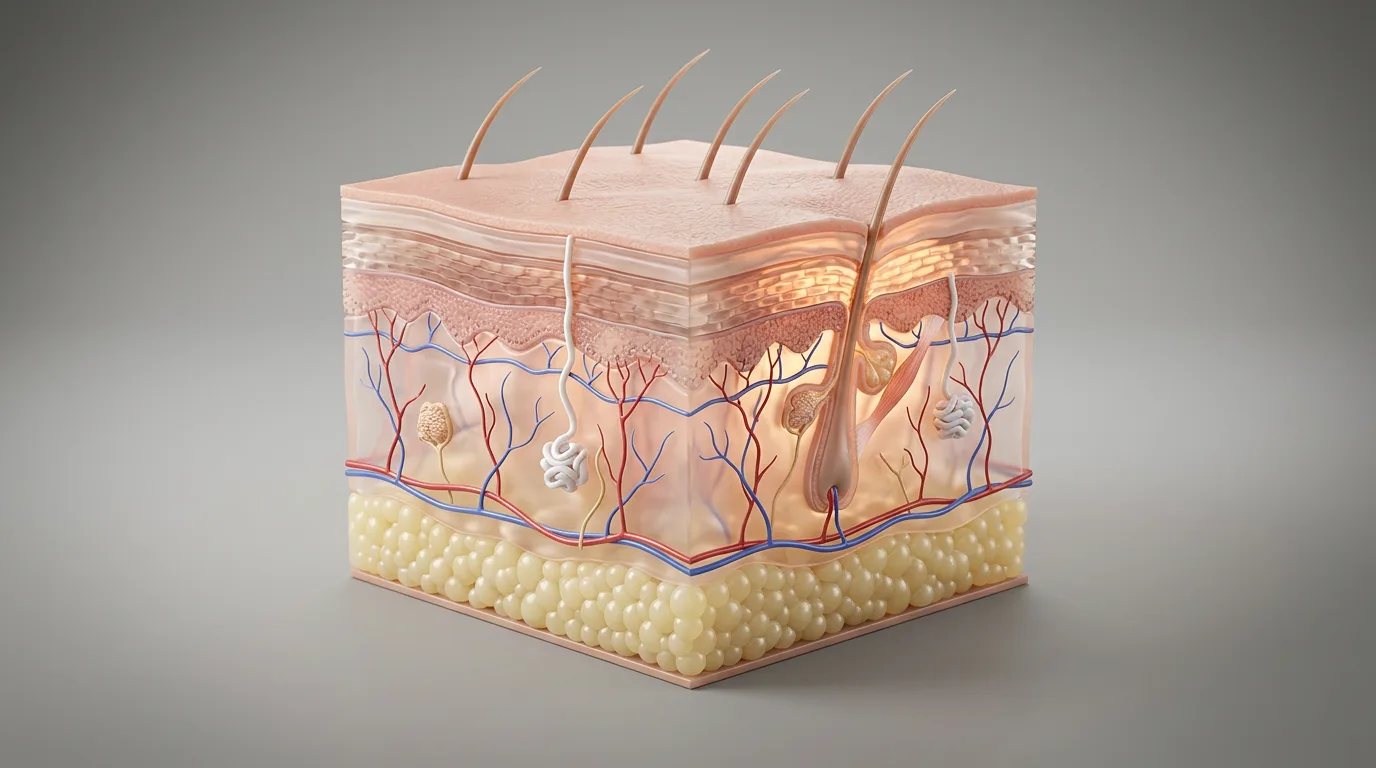
The Skin Barrier Under a Microscope
Your stratum corneum — the outermost layer of skin — is structured like a brick wall. Corneocytes (dead skin cells) are the bricks. The mortar between them is a precise mixture of ceramides (50%), cholesterol (25%), and free fatty acids (25%). This lipid matrix is what keeps water inside your body and keeps bacteria, pollution, and allergens outside.
When the ratio is right, the barrier is almost impermeable. Water loss stays below 5 grams per square meter per hour. Skin feels comfortable, resilient, and hydrated without heavy products. When ceramide levels drop — from age, UV exposure, harsh surfactants, or over-exfoliation — the mortar develops gaps. Water escapes faster (TEWL rises above 10-15 g/m²/hr), irritants penetrate more easily, and the immune system responds with inflammation. The visible result: redness, tightness, flaking, and increased sensitivity to products that previously caused no reaction.
Ceramide depletion happens gradually. By age 30, your skin produces roughly 40% fewer ceramides than at age 20. By age 50, the decline reaches 60%. This is one reason why skin becomes drier and more reactive with age even without changing products or habits. The lipid factory slows down, but demand stays constant.
The Three Ceramides That Matter Most
Scientists have identified 12 classes of ceramides in human skin, labeled by their sphingoid base and fatty acid chain. Three classes dominate the barrier and appear most frequently in effective skincare products.
- Ceramide 1 (EOS): The longest chain ceramide, spanning the full width of the lipid bilayer. It acts as a molecular rivet, holding the lamellar structure together. Without adequate Ceramide 1, the barrier loses cohesion — the mortar cracks under mechanical stress. Ceramide 1 is also the hardest to synthesize and the most expensive to include in formulations, which is why many budget products skip it.
- Ceramide 3 (NP): The most abundant ceramide in healthy skin. It drives the primary water-barrier function — the bulk of TEWL prevention comes from Ceramide 3 density. This is the ceramide most commonly used in skincare because it is relatively easy to synthesize, stable in formulation, and backed by the largest body of clinical evidence. CeraVe products build their barrier claims primarily around Ceramide NP.
- Ceramide 6-II (AP): Plays a dual role — barrier lipid and cell-signaling molecule. Ceramide 6-II helps regulate the natural desquamation process (shedding of dead skin cells). When levels are low, dead cells accumulate on the surface, causing rough texture and dull appearance. Restoring Ceramide 6-II improves both barrier function and skin smoothness simultaneously.
Research published in the Journal of Clinical Investigation found that the optimal ceramide-to-cholesterol-to-fatty-acid ratio for barrier repair is approximately 3:1:1 by molar concentration. Products that include ceramides without cholesterol and fatty acids produce weaker results — the mortar needs all three components to crystallize into the correct lamellar structure. Check the ingredient list for cholesterol and fatty acids (stearic acid, palmitic acid, or linoleic acid) alongside ceramides.
Why Your Cleanser Matters More Than Your Ceramide Cream
The biggest source of ceramide depletion is not aging — it is cleansing. Sodium lauryl sulfate (SLS) and other anionic surfactants strip ceramides from the stratum corneum with every wash. A single face wash with a high-SLS cleanser can remove 15-25% of barrier lipids. Your skin rebuilds them over 12-24 hours, but if you cleanse twice daily with aggressive surfactants, the barrier never fully recovers between washes.
Switching from an SLS-based cleanser to a non-ionic or amphoteric surfactant (like cocamidopropyl betaine or decyl glucoside) reduces ceramide stripping by 60-80%. This single change often produces more visible barrier improvement than adding a ceramide moisturizer on top of a stripping cleanser. ELEMIS Pro-Collagen Cleansing Balm dissolves makeup and sunscreen without surfactants at all — the oil-based formula lifts debris without disrupting the lipid matrix. Drunk Elephant Marula Oil serves a similar barrier-preserving function when used as the first step in a double-cleanse routine.
The foam trap. Foaming cleansers feel satisfying because the lather signals "clean." But foam is created by surfactants, and most surfactants strip barrier lipids. If your face feels tight or squeaky after cleansing, the cleanser is removing ceramides faster than your skin can replace them. A properly formulated cleanser leaves skin feeling clean but not tight — a subtle difference that protects your barrier long-term.
Ceramides and Retinol: The Essential Pairing
Retinol accelerates cell turnover in the epidermis. Fresh cells push to the surface faster, shedding dead cells and revealing smoother skin underneath. The side effect: the lipid barrier thins temporarily during this accelerated turnover. Ceramide production cannot keep pace with the faster cell cycle, and the result is the dryness, peeling, and irritation that retinol beginners experience during the first 4-8 weeks.
Topical ceramides solve this by supplying barrier lipids externally while retinol disrupts the internal production cycle. Applied after retinol, a ceramide-rich moisturizer seals the barrier, reduces water loss, and dramatically cuts the severity of retinol side effects. Published studies comparing retinol alone versus retinol plus ceramides show 40-60% less irritation in the ceramide group with identical anti-aging efficacy.
CeraVe Retinol Serum combines encapsulated retinol with three essential ceramides in one formula, eliminating the need for layering. La Roche-Posay Retinol B3 Serum takes a different approach — retinol with niacinamide for calming, designed to be followed by a separate ceramide moisturizer for full barrier protection. Both strategies work; the choice depends on whether you prefer one step or two.
How Ceramide Products Actually Deliver
Ceramides are lipids that do not dissolve in water. Getting them from a bottle into the stratum corneum requires specific formulation technology. Three delivery methods are common.
Lamellar emulsions: The most effective delivery system. The product is structured to mimic the skin's own lipid bilayer, with ceramides pre-arranged in lamellar (sheet-like) structures. When applied, these sheets merge with the existing barrier, depositing ceramides exactly where they belong. CeraVe uses MVE (MultiVesicular Emulsion) technology — concentric rings of moisturizing ingredients that release ceramides gradually over 24 hours.
Liposomal delivery: Ceramides are encapsulated in phospholipid vesicles (liposomes) that fuse with cell membranes on contact. Effective for targeted delivery of specific ceramide types. More common in prestige formulations. Augustinus Bader The Rich Cream uses a proprietary delivery system that includes barrier lipids alongside its TFC8 complex for deep penetration into the stratum corneum.
Simple emulsions: Ceramides dissolved or suspended in a standard oil-in-water cream base. Less efficient delivery than lamellar or liposomal methods, but still effective at higher concentrations. Most budget ceramide products use this approach — it works, just less precisely.
Ceramides and Aging: The Declining Lipid Budget
Your skin synthesizes ceramides through a process involving serine palmitoyltransferase and ceramide synthase enzymes in the epidermis. These enzymes lose activity with age. A 2009 study in the Journal of Lipid Research measured ceramide levels in skin biopsies across age groups and found a consistent decline: 10% less per decade after age 20. By age 60, the stratum corneum contains roughly 40% fewer ceramides than the same tissue at age 20.
The composition shifts too. Younger skin has a higher proportion of long-chain ceramides (Ceramide 1/EOS) that span the full lipid bilayer and hold the structure together. Older skin skews toward shorter-chain ceramides that provide less structural integrity. The mortar thins and weakens — not just in quantity but in quality. This explains why mature skin becomes drier and more fragile even in humid climates where external moisture is abundant. The problem is not water availability. The problem is the container leaking.
Topical ceramides cannot fully reverse this age-related decline, but they can meaningfully compensate. A well-formulated ceramide moisturizer applied twice daily provides a continuous external supply that supplements what the enzymes no longer produce at full capacity. Augustinus Bader Ultimate Soothing Cream targets this age-related depletion specifically, combining barrier lipids with its TFC8 complex to support the skin's own repair mechanisms alongside the external lipid supply.
Pseudo-Ceramides and Synthetic Alternatives
Not all ceramide products use human-identical ceramides. Some formulations include pseudo-ceramides — synthetic molecules designed to mimic ceramide function without being structurally identical. Cetyl-PG hydroxyethyl palmitamide is the most common pseudo-ceramide, used widely in Japanese and Korean skincare. Published studies show it provides barrier repair comparable to natural ceramides at equivalent concentrations, though the lamellar organization may differ slightly.
Phytoceramides — ceramides derived from plants (wheat, rice, sweet potato) — represent another alternative. They share the sphingoid base structure with human ceramides but have different fatty acid chain lengths. Phytoceramides are available both as topical ingredients and oral supplements. The topical form works similarly to synthetic ceramides for barrier repair. The oral supplement form is more controversial — some studies show improved skin hydration after 8-12 weeks of daily phytoceramide capsules, but the effect size is smaller than topical application and the research is limited.
Signs Your Barrier Needs Ceramides
Not everyone needs a dedicated ceramide product. If your skin is comfortable, hydrated, and tolerates its current routine without sensitivity, your endogenous ceramide production is adequate. Add ceramides when you see these signals.
- Tightness after cleansing that lasts more than 5 minutes — indicates lipid stripping exceeds recovery speed.
- Products that previously worked now sting — weakened barrier allows ingredients to penetrate too deeply, triggering nerve endings that intact barrier would shield.
- Flaking without using exfoliants — the skin is shedding because the lipid mortar is not holding cells together, not because of active exfoliation.
- Increased redness or reactive flushing — compromised barrier allows inflammatory triggers (temperature changes, fragrance, alcohol) to reach deeper skin layers.
- Starting retinol or increasing acid frequency — proactive ceramide use before barrier stress prevents the damage-repair cycle entirely.
If your barrier is damaged from over-exfoliation or retinol adaptation, pause all actives for two weeks. Use only a gentle cleanser, ceramide moisturizer, and SPF. Kiehl's Ultra Facial Cream or Tatcha Dewy Skin Cream both deliver ceramide-compatible barrier repair in rich, occlusive formulas. After two weeks, reintroduce actives one at a time, starting at half your previous frequency.
Ceramide Products Worth Knowing
CeraVe Retinol Serum: Three essential ceramides (1, 3, 6-II) with encapsulated retinol in MVE technology. The ceramides repair barrier damage as the retinol creates it. Under $20, it is the benchmark for accessible ceramide-retinol combination therapy.
La Roche-Posay Hyalu B5 Serum: Combines hyaluronic acid with Madecassoside — a barrier-repair compound that works synergistically with the skin's own ceramide production. Designed for post-procedure and compromised skin recovery. Lightweight enough to layer under any ceramide moisturizer.
Augustinus Bader The Rich Cream: Prestige barrier repair with a proprietary TFC8 complex that includes amino acids, vitamins, and synthesized barrier lipids. The richest texture in the category — designed for dry, mature, or severely compromised skin. Results are measurable but so is the price tag.
ELEMIS Pro-Collagen Marine Cream: Marine-derived actives with padina pavonica algae for hydration and barrier support. Lighter than Augustinus Bader, with a gel-cream texture that works for combination skin. The marine approach to barrier lipid supplementation offers an alternative to traditional ceramide formulations.
How to choose: Budget-conscious buyers start with CeraVe — the ceramide formulation is clinical-grade regardless of the price. Sensitive or post-procedure skin benefits from La Roche-Posay Hyalu B5 as a repair serum. Dry or mature skin that needs maximum occlusion reaches for Augustinus Bader. Combination skin prefers ELEMIS for its lighter texture. The ceramides work the same across all four — the differentiator is texture, delivery system, and secondary actives.
Common Questions About Ceramides
What do ceramides actually do for skin?
Ceramides are lipids that form the mortar between skin cells in the stratum corneum. They prevent water from escaping and block irritants from entering. When ceramide levels drop — from aging, harsh cleansers, or over-exfoliation — the barrier weakens, leading to dryness, sensitivity, and inflammation. Topical ceramides replenish what is missing and restore barrier function within 2-4 weeks of consistent use.
Can you use ceramides with retinol?
Absolutely. Ceramides are one of the best ingredients to pair with retinol. Retinol accelerates cell turnover and can thin the lipid barrier temporarily, causing dryness and irritation. Ceramides rebuild that barrier as fast as retinol disrupts it. Apply retinol first, then a ceramide-rich moisturizer on top. CeraVe Retinol Serum combines both in one formula for this reason.
Are all ceramides the same?
No. There are 12 identified ceramide classes in human skin. Ceramides 1, 3, and 6-II are the three most studied and most commonly used in skincare. Effective products typically include a blend of at least two ceramide types plus cholesterol and fatty acids in a ratio that mimics the natural skin barrier composition. A product listing just one ceramide type is less effective than a multi-ceramide formula.
How long do ceramides take to work?
Barrier repair from topical ceramides is measurable within 2-4 weeks. TEWL (transepidermal water loss) readings improve within 14 days in published studies. The skin feels less tight and reactive within the first week for most people. Full barrier restoration — where the skin tolerates actives like retinol and acids without excessive irritation — typically takes 4-6 weeks of twice-daily application.
Do expensive ceramide products work better than drugstore ones?
Not necessarily. CeraVe and La Roche-Posay both use effective multi-ceramide formulations at drugstore prices. The ceramide molecules are identical regardless of the brand charging for them. What differs between price tiers is the delivery system, additional actives, and texture. A prestige ceramide cream may include peptides or growth factors alongside ceramides, but the barrier-repair function comes from the ceramides themselves — and those work the same at every price point.
Can ceramides cause breakouts?
Ceramides themselves are non-comedogenic. They are naturally present in your skin and do not clog pores. If a ceramide product causes breakouts, the culprit is usually the vehicle — heavy occlusives, emulsifiers, or coconut-derived fatty acids in the base formula. Switch to a lighter ceramide gel-cream or serum rather than abandoning ceramides entirely. Your barrier still needs them.
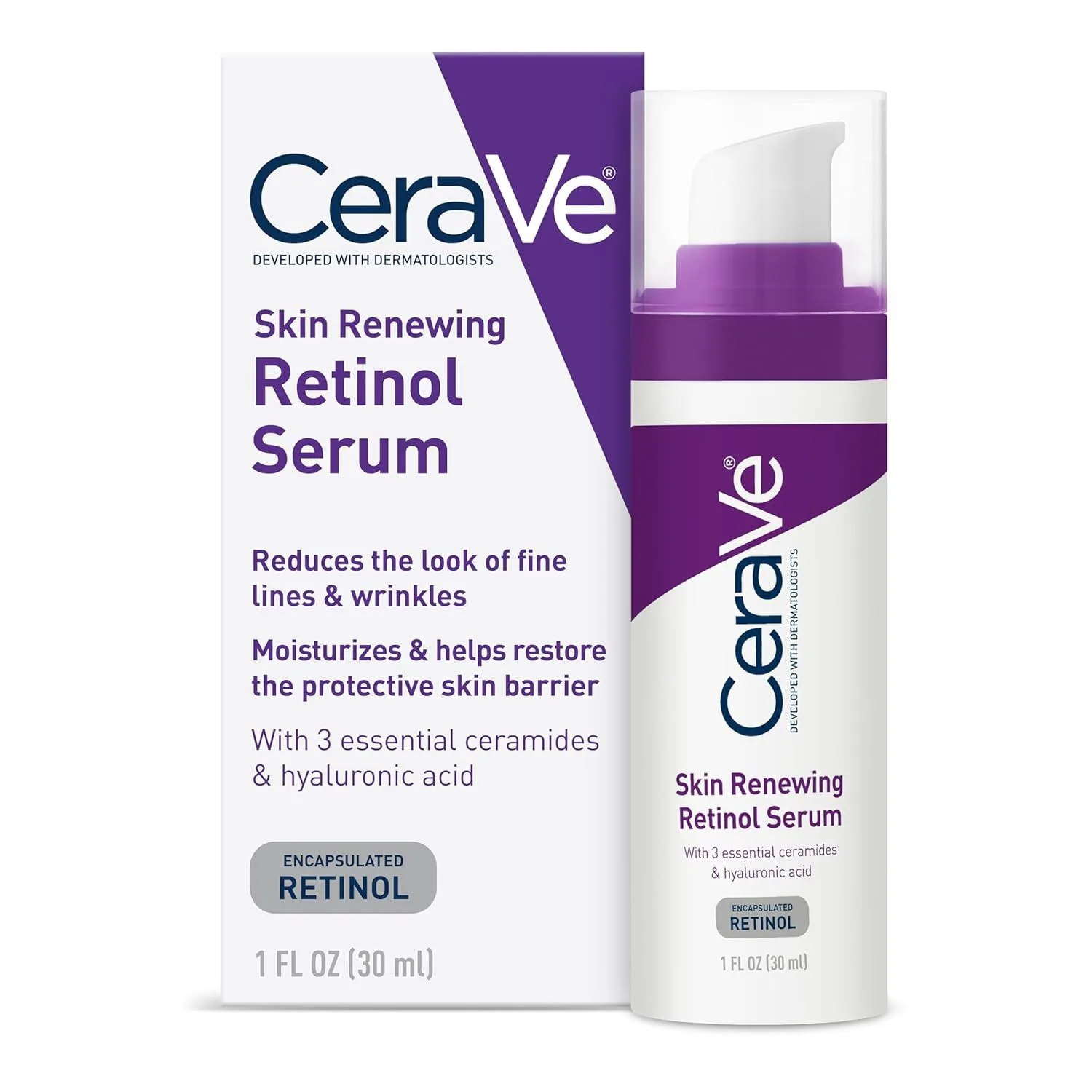
Three essential ceramides with retinol in MVE delivery — barrier repair and anti-aging in one step
Get Luxury Skincare Picks Delivered
One email per week. Honest reviews, no spam.
No spam. Unsubscribe anytime.
Watch: Dr. Shereene Idriss's take on the Ceramides Explained | Barrier Repair
