CeraVe Retinol Serum vs La Roche-Posay Retinol B3: Which Is Better in 2026?
Both come from dermatologist-trusted brands. Both are formulated to minimize retinol's notorious irritation. But CeraVe built a safety net for beginners, while La Roche-Posay built a stepping stone for those ready for more. CeraVe is budget-friendly, La Roche-Posay is roughly double the price — and the concentration difference reflects two very different skin-readiness assumptions.
Quick Verdict: CeraVe is the right retinol if you have never used one before. La Roche-Posay is the right retinol when CeraVe stops being enough. Most people should start with CeraVe and graduate to La Roche-Posay after 4-6 months — that progression is exactly how dermatologists recommend building retinol tolerance.
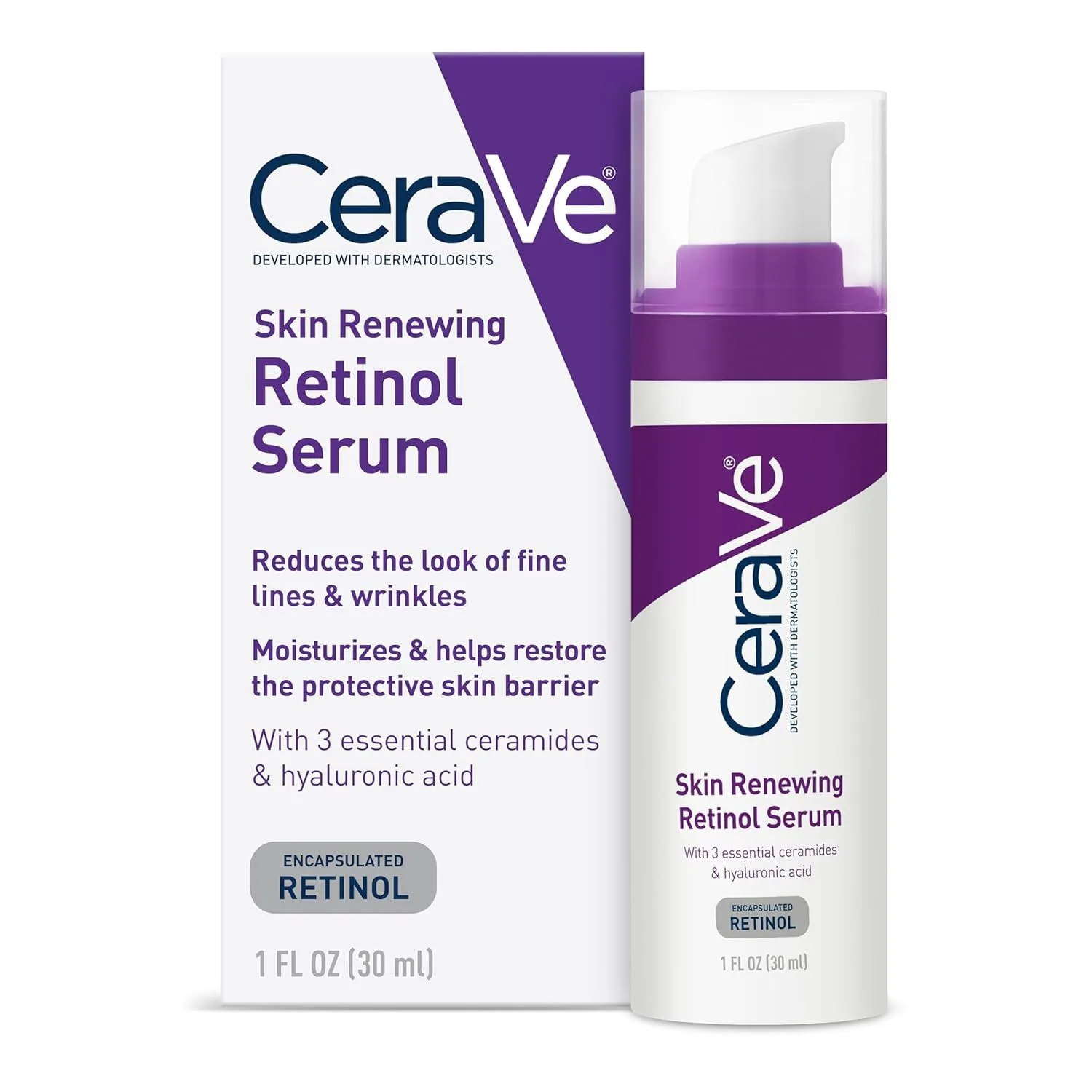
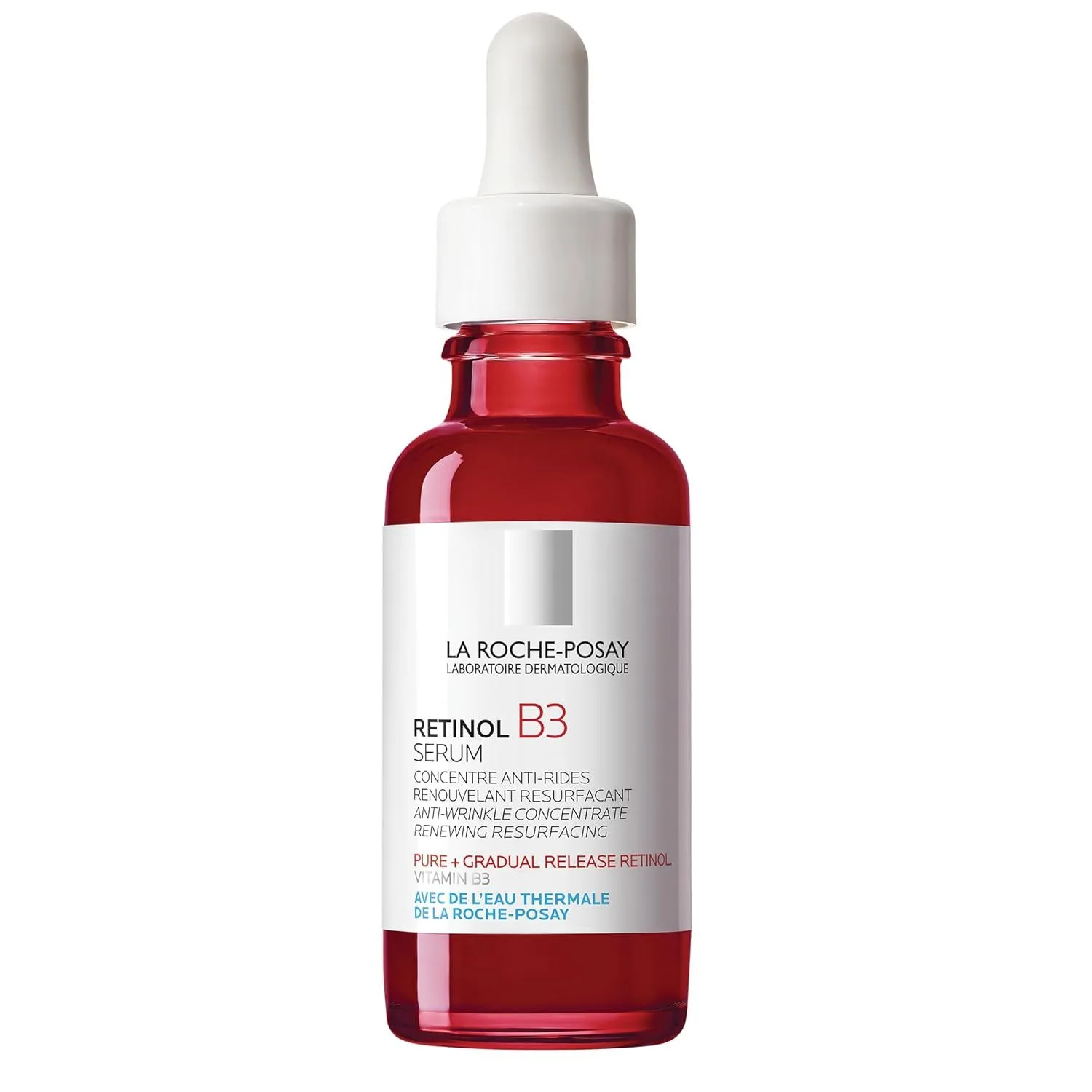
At a Glance
| Feature | CeraVe Anti Aging Retinol Serum | La Roche-Posay Retinol B3 Serum |
|---|---|---|
| Price Range | Under $25 | $25–$50 |
| Size | 30ml / 1 fl oz | 30ml / 1 fl oz |
| Best Skin Type | Sensitive & beginner skin | All skin types incl. sensitive |
| Key Ingredient | Encapsulated Retinol + Ceramides | 0.3% Pure Retinol + Niacinamide |
| Active Concentration | Low (encapsulated) | 0.3% Pure Retinol |
| Texture | Cream-serum hybrid | Fluid serum |
| Fragrance | Fragrance-free | Fragrance-free |
| See Availability | See Availability |
Your Skin Has Never Tried Retinol — Which Door Do You Open?
CeraVe designed its formula as the gentlest possible introduction. Encapsulated retinol releases gradually, preventing the concentration spike that causes redness and flaking. Ceramides actively repair the barrier while the retinol works. The combined effect: your skin adjusts to retinol without the uncomfortable initiation period that scares most beginners off the ingredient permanently. La Roche-Posay's 0.3% is not aggressive — but it assumes your skin has some active ingredient experience. First-timers should start with CeraVe.
Four Months In — Which Formula Still Challenges Your Skin?
La Roche-Posay's 0.3% pure retinol maintains efficacy past the point where CeraVe plateaus. Most users report that CeraVe's low concentration stops producing visible improvement after 3-4 months — the skin has fully adapted and needs a higher dose. La Roche-Posay's 0.3% continues to drive cell turnover and fine line reduction for 8-12 months before users typically want to step up again. If you are already retinol-experienced, skip CeraVe entirely — it is below the threshold where your adapted skin will respond.
The plateau effect deserves more attention because it is the most common reason people abandon retinol entirely — our retinol explainer covers the science behind tolerance building. Users start with a low-concentration product, see improvement for a few months, then assume retinol "stopped working" when results level off. What actually happened: their skin adapted to the dose. The fix is not to quit — it is to increase the concentration. CeraVe to La Roche-Posay is the cleanest version of that step-up because both brands formulate with barrier support in mind, and the jump from encapsulated low-dose to 0.3% pure retinol is calibrated to challenge adapted skin without overwhelming it. Going straight from CeraVe to a 1% retinol is too large a leap for most people and risks the irritation cycle that makes retinol seem like an inherently harsh ingredient.
The Niacinamide Advantage
La Roche-Posay pairs its retinol with high-dose niacinamide (Vitamin B3). Published research shows niacinamide reduces the inflammation that retinol causes — cutting the irritation window from weeks to days. The thermal spring water base adds mineral-rich soothing. CeraVe uses niacinamide too, but its primary support system is ceramides. Both combinations work, but La Roche-Posay's niacinamide emphasis delivers a more noticeable calming effect during the adjustment period. See our best retinol treatments ranked for how both compare to the full field.
The niacinamide concentration difference between the two products has downstream effects beyond irritation management. At the levels present in La Roche-Posay's formula, niacinamide actively reduces hyperpigmentation and helps regulate melanin production — benefits that accumulate over months of consistent use. Users dealing with post-inflammatory hyperpigmentation from acne scars or sun damage get a dual benefit from La Roche-Posay: retinol accelerates cell turnover to fade discoloration, while niacinamide slows the overproduction of melanin that caused the dark spots in the first place. CeraVe's lower niacinamide concentration supports barrier function but does not reach the threshold where pigmentation benefits become clinically observable.
What Does Each Formula Actually Feel Like?
CeraVe has a cream-serum hybrid texture — slightly thick, somewhat heavy under rich night creams. It functions as both treatment and light moisturizer. La Roche-Posay is a true fluid serum — thin, fast-absorbing, and nearly weightless. It layers under any night cream without adding bulk. If your evening routine involves multiple steps, La Roche-Posay's fluid texture integrates more easily. If you want a simpler routine where the retinol step doubles as light moisture, CeraVe's richer texture serves both purposes.
Dollar for Dollar: Where Does the Value Land?
CeraVe is one of the most affordable retinol serums available — budget-friendly for a clinically formulated retinol is exceptional. La Roche-Posay is roughly double the price but delivers a higher concentration and more sophisticated calming system. Both are excellent value for what they offer. CeraVe wins on absolute price. La Roche-Posay wins on price-per-effective-unit-of-retinol — more potency per dollar.
Packaging and Stability: Which Protects the Formula Better?
CeraVe uses an opaque tube with an airless pump — the gold standard for retinol stability. The formula never contacts air or light during normal use, which means the retinol maintains its potency from the first pump to the last. La Roche-Posay uses a glass dropper bottle. Every time you open the dropper, you introduce air and light to the remaining formula. Glass looks premium on a bathroom shelf, but for a light-sensitive ingredient like retinol, it is a design choice that prioritizes aesthetics over formulation integrity. Over a 3-month use period, CeraVe's retinol degrades measurably less than La Roche-Posay's.
Storage habits amplify this difference. If you keep your retinol in a bathroom cabinet away from direct light, both products maintain acceptable stability. But if your bottle sits on an open shelf near a window or under bright bathroom lighting — a common scenario — La Roche-Posay's clear glass exposes the formula to degradation that CeraVe's opaque tube prevents entirely. For users who travel frequently and toss skincare into bags exposed to sunlight, CeraVe's packaging is not just better — it is the only practical option for maintaining retinol potency on the go. La Roche-Posay's glass dropper also poses a breakage risk in travel bags that CeraVe's flexible tube avoids.
Long-Term Skin Benefits: What Happens After 6 Months?
CeraVe's ceramide-focused approach builds long-term barrier health alongside the retinol's resurfacing effects. After 6 months, users typically report skin that feels stronger and more resilient — less reactive to weather changes, less prone to dehydration, more tolerant of other actives. The retinol itself plateaus, but the barrier benefits compound. La Roche-Posay's niacinamide delivers its own long-term benefits — reduced pore visibility, more even skin tone, and improved moisture retention — alongside the retinol's anti-aging effects. After 6 months with La Roche-Posay, the niacinamide benefits are often more noticeable than the retinol results, which is an unexpected but welcome outcome.
How Each Product Fits Into a Complete Nighttime Routine
CeraVe's cream-serum hybrid texture means it can function as both your retinol treatment and your light moisturizer. For beginners building a minimal routine (cleanser → retinol → done), CeraVe simplifies the process. Add a heavier night cream on top only if your skin feels dry after the CeraVe absorbs. La Roche-Posay's fluid texture is designed to sit under a separate night cream. The typical routine with La Roche-Posay: cleanser → Retinol B3 serum → wait 2 minutes → night cream. The extra step adds time but gives you more control over your overall moisture level.
One overlooked routine consideration: how each product interacts with prescription acne treatments. Users on benzoyl peroxide or topical antibiotics for breakouts should know that CeraVe's ceramide base acts as a buffer between the acne treatment and the retinol, reducing the compounded drying effect that two active treatments can produce. La Roche-Posay's thinner fluid offers less of that protective cushion. Dermatologists often recommend the "sandwich method" — moisturizer, then retinol, then moisturizer — for patients using both acne medication and retinol, and CeraVe's creamier texture works naturally within that framework. La Roche-Posay requires a separate moisturizer layer to achieve the same buffering effect.
Who Should Get Which?
Get CeraVe Retinol Serum If...
- This is your first retinol product — you have never used retinoids before
- Your skin is sensitive, easily irritated, or recently had barrier damage
- You want the most affordable entry point into retinol skincare
- You prefer a cream-serum texture that doubles as light moisture
- Packaging stability matters — you want retinol that stays potent throughout the bottle
Get La Roche-Posay Retinol B3 If...
- You have used a beginner retinol for 4+ months and want to level up
- Your skin tolerates active ingredients without excessive irritation
- You want visible fine line and wrinkle reduction within the first month
- You prefer a lightweight fluid texture that layers easily under night cream
- Niacinamide synergy appeals — you want pore refinement alongside retinol anti-aging
Frequently Asked Questions
Which retinol is better for a complete beginner?
CeraVe. Its encapsulated retinol at a low concentration is specifically designed for people who have never used a retinoid. The ceramide buffer reduces irritation during the adjustment period. Start with every other night and build to nightly over 2-3 weeks.
Can I layer either of these with Vitamin C?
Apply Vitamin C in the morning and retinol at night. Do not layer them simultaneously — the low pH of Vitamin C can destabilize retinol, and the combination increases irritation risk. Both CeraVe and La Roche-Posay retinols pair well with a morning Vitamin C when used at separate times.
How long before I see results with either serum?
CeraVe's lower concentration shows subtle texture improvement in 4-6 weeks, with anti-aging benefits building gradually over 3-4 months. La Roche-Posay's 0.3% shows visible results faster — fine line reduction in 3-4 weeks, with ongoing improvement over 8-12 weeks.
Will either of these cause peeling?
CeraVe's encapsulated delivery and ceramide support make peeling unlikely at this concentration. La Roche-Posay's 0.3% can cause mild flaking during the first 1-2 weeks as skin adjusts, though the niacinamide helps minimize this. Neither is as likely to peel as a 1% retinol or prescription tretinoin.
Which has better packaging for retinol stability?
CeraVe's opaque tube with pump minimizes light and air exposure. La Roche-Posay's glass dropper is more susceptible to light and oxygen with each use. For retinol stability specifically, CeraVe's packaging is the smarter design.
Skin Type Considerations
Oily skin: La Roche-Posay's fluid texture is the better match. CeraVe's cream-serum hybrid can feel heavy on oily skin types, especially when layered under a night cream. The lighter fluid absorbs cleanly without adding moisture that oily skin does not need. The niacinamide in La Roche-Posay also helps regulate sebum production, which is a secondary benefit for oily skin.
Dry skin: CeraVe's ceramide-enriched formula provides built-in barrier support that dry skin needs. The cream-serum texture delivers both retinol treatment and light moisture in one step, reducing the need for heavy layering. Dry skin types using La Roche-Posay will need a richer night cream on top to compensate for the fluid's lack of occlusive moisture.
Sensitive skin: CeraVe is the safer choice. The encapsulated retinol and lower concentration minimize the irritation risk that sensitive skin types fear most. La Roche-Posay's 0.3% is manageable for mildly sensitive skin, especially with the niacinamide buffer, but highly reactive skin should start with CeraVe and only consider graduating after 6+ months of tolerance building.
Combination skin: Either works, but the texture difference matters. CeraVe's cream-serum hybrid may feel heavy on the oily T-zone while providing comfortable coverage on dry cheeks. La Roche-Posay's fluid texture distributes more evenly across zones with mixed moisture levels. For combination skin, apply a thinner layer of CeraVe on the T-zone and a normal layer on the cheeks — or choose La Roche-Posay for a more uniform application.
What the Reviews Say: Real User Experience
CeraVe's retinol serum sits on Amazon with thousands of reviews averaging above 4 stars. The most common praise: "no irritation" and "good for beginners." The most common complaint: the pump mechanism occasionally fails, trapping the last 15-20% of product in the tube. A practical annoyance for an otherwise reliable formula. Users report texture improvement within 3-4 weeks and gradual fine-line softening over 3 months.
La Roche-Posay's reviews highlight the niacinamide synergy — users frequently mention reduced redness and pore size alongside the anti-aging benefits, suggesting the niacinamide is doing meaningful work beyond buffering irritation. The glass dropper design gets mixed reviews: beautiful on the shelf, fragile for travel, and poor for retinol stability. Users who switch from CeraVe to La Roche-Posay consistently describe it as "the next level" — confirming the ladder progression that both brands seem to have designed around.
Application Best Practices for Both Serums
Seasonal adjustments matter with both products. During winter months when indoor heating strips moisture from the air, even retinol-adapted skin can become more reactive. CeraVe's ceramide base provides extra buffer during dry seasons, while La Roche-Posay users may need to add a richer night cream or reduce application frequency to every other night until humidity levels recover. Summer brings the opposite concern — increased UV exposure amplifies the photosensitivity that retinol causes, making strict SPF adherence and reduced retinol frequency reasonable adjustments during peak sun months. Neither brand adjusts its formulation seasonally, so users need to modify their own routine to match environmental conditions.
Apply either serum to clean, dry skin in the evening. Wait 20 minutes after cleansing — freshly washed skin is more permeable, and applying retinol to slightly damp skin increases penetration beyond what the formula was calibrated for, raising irritation risk. Use a pea-sized amount for the full face. Avoid the immediate eye area (the skin there is thinner and more reactive). Follow with a simple moisturizer — ceramide-based for CeraVe, or any non-active night cream for La Roche-Posay. Both serums work best when the rest of the routine is gentle. Do not layer with AHAs, BHAs, or Vitamin C on the same night. And always — without exception — apply SPF 30 or higher the next morning. Retinol increases photosensitivity for 24-48 hours after each application.
Retinol and SPF: The Non-Negotiable Pairing
Both CeraVe and La Roche-Posay retinols increase photosensitivity — your skin becomes more vulnerable to UV damage during the weeks following retinol introduction. This is not optional advice. SPF 30 or higher every morning is a requirement, not a recommendation, when using any retinol product. Without daily sunscreen, retinol can cause more visible sun damage than it prevents in aging signs. Apply retinol at night, SPF in the morning. Every day. Even cloudy days. Even if you work indoors near windows. UV penetrates glass and clouds. The retinol is working — protect what it is building.
How Each Formula Performs Over Three Months
CeraVe weeks 1-4: Skin adjusts to the encapsulated retinol with minimal irritation. Most users notice softer texture by week three. The ceramide barrier support keeps moisture levels stable during the adjustment period. No dramatic changes — this is a gentle ramp-up phase.
CeraVe weeks 5-12: Texture improvement becomes clearly visible. Pores appear smaller on close inspection. Fine lines soften slightly. By week twelve, most of CeraVe's benefits have fully materialized. The skin has adapted to the low concentration, and further improvement stalls. This is the natural graduation point to La Roche-Posay.
La Roche-Posay weeks 1-4: Users coming from CeraVe experience mild flaking in the first week as skin recalibrates to the higher concentration. By week two, the niacinamide calming effect kicks in and flaking resolves. By week four, fine line reduction is visible — more pronounced than CeraVe achieved at the same timeframe.
La Roche-Posay weeks 5-12: This is where the 0.3% concentration earns its place. Continued cell turnover improvement, more visible wrinkle softening, and increasingly even skin tone from the niacinamide. The formula continues to challenge the skin in productive ways that CeraVe no longer can. Most users see ongoing improvement through month six before considering a further step up.
See Both Products in Action


Final Verdict
These are not rivals — they are stages. CeraVe is where you start. La Roche-Posay is where you graduate. Buying the wrong one for your skin's current experience level either wastes the formula (La Roche-Posay on untested skin causes unnecessary irritation) or wastes your time (CeraVe on adapted skin stops producing improvement). Match the product to your skin's retinol history and both deliver exactly what they promise. Our complete retinol guide covers how to build tolerance step by step. The beauty of this pairing is that the graduation path is built in — CeraVe teaches your skin to tolerate retinol, La Roche-Posay takes that tolerance and pushes it toward visible anti-aging results that a beginner formula cannot achieve on its own.
Track Both Products
We'll email you if either price drops or availability changes.
Only when something changes. Unsubscribe anytime.